Exxaro Resources Limited
Integrated report for the year ended 31 December 2025


Responsibly managing and mitigating the negative impacts of our activities on the environment is not only critical to our success and sustainability as a business, but also to supporting a sustainable future for our employees, communities and the planet.
Exxaro’s natural capital refers to the natural resources we use to run our business and create the products and services we deliver to our stakeholders. Our natural capital impact spans climate change mitigation, adaptation and resilience; air quality; energy; water; waste; biodiversity; environmental liabilities; land management; and rehabilitation.
We are committed to being responsible stewards of the natural resources we rely on, understanding that mining can result in long-lasting environmental impacts if unmanaged. Our strategy guides our approach in managing these impacts, and we embed performance principles into our ESG management systems, environmental policies and practices. We also comply with local legislation, management standards, and current and future-based best practice.
| Material theme | Matters | Strategies to achieve our objectives | Related strategic objectives | Our broader impact | ||
 Executing our strategy |
|
|
  |
 |
||
 Principled governance |
|
|||||

Responsible environmental stewardship |
|
| Climate change mitigation, adaptation and resilience | Approved the decarbonisation roadmap and advanced site-specific climate change adaptation and resilience plans | |
| Environmental stewardship | Surpassed R1 billion in approved grants and loan funding through the ESD programme since 2018 | |

Looking
ahead
Read our Our environmental stewardship
Our response combines structured governance, regulatory compliance and proactive stewardship. Through group standards, monitoring systems and risk-based management, we aim to protect natural resources and strengthen climate resilience, while supporting South Africa’s transition to a lower-carbon and more resource-efficient economy
Refer to the ESG databook for our response to TCFD reporting requirements.
| How we deliver our strategic transition | Detailed disclosure in our ESG report | |||
| Governance oversight | Our board and its committees retain oversight of climate-related risks, opportunities and performance. Climate considerations are integrated into executive oversight, strategic planning and capital allocation, ensuring alignment with our decarbonisation roadmap and long-term transition objectives. | |||
| Strategy integration | We are repositioning the business through investments in renewable energy and energy transition metals, while improving operational efficiency. This diversification strengthens resilience, reduces emissions intensity and aligns our portfolio with evolving market and policy conditions. | |||
| Implementing our decarbonisation roadmap | In 2025, the board approved a group-wide decarbonisation roadmap that guides emissions reduction across scope 1 and 2 through energy efficiency, fleet optimisation and renewable integration, while supporting value chain collaboration and credible offsets to address scope 3 over time. |
Decarbonising our operations and responding to a changing climate |
||
| Measuring, managing and reporting on performance | We monitor and report energy and carbon data in line with the GHG Protocol and regulatory requirements, participate in CDP (formerly the Carbon Disclosure Project) climate and water programmes and continue strengthening data quality, monitoring systems and emissions accounting methodologies. | |||
| Collaboration | We partner with customers, suppliers, research institutions and industry bodies to support emissions reduction, technology innovation and coordinated transition planning across the value chain. | |||
| Addressing risks | Climate-related risks and opportunities are embedded in ERM processes and resilience planning, supported by scenario analysis, adaptation planning and regulatory alignment under the Climate Change Act. | |||
Carbon emissions
Engagement purpose
Diversification
We leverage five interconnected pillars to balance emissions reduction, feasibility and social impact:
| Action area | Focus areas | Outcome | ||
| Assets reconfiguration | Renewable energy integration, energy management systems, as well as fleet and haulage optimisation | Reduce scope 1 and 2 emissions through operational efficiency and technology upgrades | ||
| Portfolio diversification | Disposal of non-core assets and diversification into metals required for the just energy transition and renewable energy | Transition the portfolio towards resilient metals and renewable energy | ||
| Conscious scope 3 reduction | Strategic partnerships with customers and logistics providers | Work with value chain partners to reduce downstream emissions while supporting national energy needs | ||
| Carbon offset | Nature-based solutions, alongside regional renewable energy support | Use credible offsets where emissions are unavoidable | ||
| Impactful transition | Skills development and livelihood resilience | Ensure workers, suppliers and vulnerable communities are supported through the transition | ||
Our roadmap, approved in 2025, prioritises practical and scalable interventions that balance technology readiness, operational feasibility and funding availability over time. It outlines short, medium and long-term milestones to achieve carbon neutrality by 2050 and will be reviewed periodically to reflect market developments, regulatory shifts and portfolio changes.
We started developing site-specific climate change adaptation and resilience plans that will identify climate risks, define adaptation pathways and consider technological solutions to support each operation.
Climate-related risks and opportunities are integrated into Exxaro’s ERM processes and strategic decision making, ensuring transition and physical climate risks are addressed alongside emerging opportunities.
Our understanding of climate change-related risks is informed by a scenario analysis conducted in 2019 and 2020, a water security study completed in 2025, and the development of site-specific climate change adaptation and resilience plans now underway across business units. These plans strengthen operational resilience by identifying physical risk pathways and practical adaptation measures.
All Exxaro assets are exposed to both transition and physical climate risks, which remain material to our operating context.
Our response to these risks is unpacked in the 2020 Climate Change Response strategy report (investor tab under integrated reports 2020) and 2020 Climate Change Position statement (sustainability tab).
Total carbon intensity*
4.71tCO2e/ktTM
(2024: 4.12tCO2e/ktTM)
Scope 1 emissions
1.64tCO2e/ktTM
(2024: 1.49tCO2e/ktTM)
Scope 2 emissions
3.07tCO2e/ktTM
(2024: 2.63tCO2e/ktTM)
Supporting research and development in climate change R0.3 million
| * | Only the operating mines’ carbon emissions were taken into account for the intensity calculations. This excludes the ConneXXion, Durnacol, Hlobane, FerroAlloys, Tshikondeni and Ferroland Manketti. |
The increase in carbon intensity reflects the decrease in annual RoM total tonnes mined, and the increase in Eskom’s grid emission factor to 1.08tCO2e/MWh (2024: 1.04tCO2e/MWh). Despite this, our year-to-date carbon intensity is below the 2025 target of 4.83tCO2e/total tonnes mined. Delivery of the LSP and additional renewable and efficiency initiatives will support progress toward our 2030 reduction pathway.
For information on our CDP performance, please refer to www.cdp.net and the ESG databook.
Scaling renewable energy and diversifying into energy transition metals
Value chain collaboration
We signed an MoU with Eskom to explore joint opportunities to measure, manage and reduce scope 1, 2 and 3 emissions across the power value chain. This collaboration supports technology deployment, reporting transparency and workforce transition initiatives in line with South Africa’s decarbonisation pathway.

Our priority actions for 2026 include:
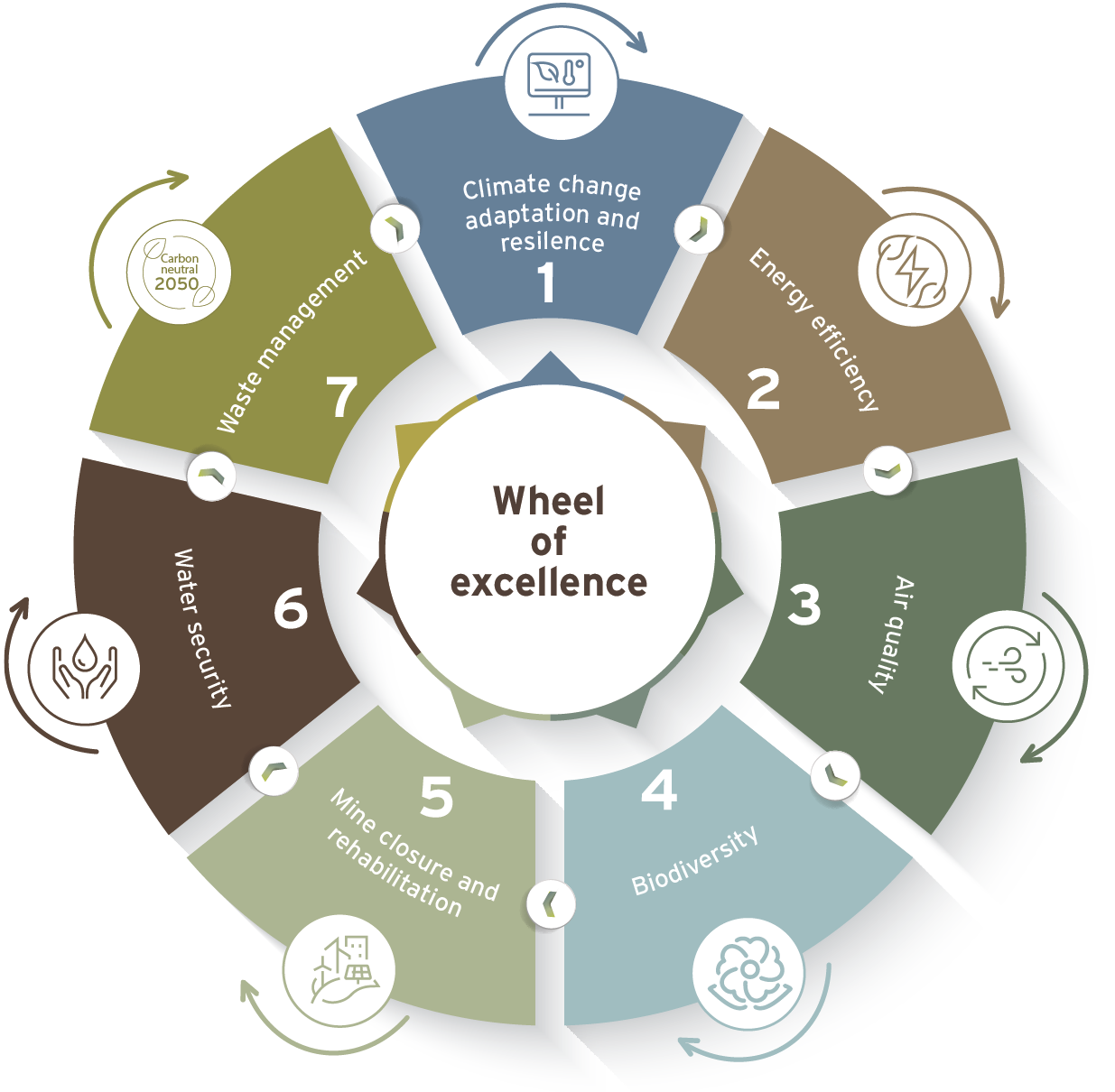
Our environmental commitments are organised into seven interconnected focus areas that together manage environmental risk, protect natural systems and strengthen operational resilience. Each focus area is supported by targeted strategies, standards and management practices that guide day-to-day performance as well as long-term environmental outcomes.
1 Climate change adaptation and resilience: We are building our climate resilience by enhancing the adaptive capacity of Exxaro and communities and capitalising on strategic opportunities presented by the transition to a low‑carbon economy.
2 Energy efficiency: Our energy and carbon management programme drives efficiencies that support the transition to a low-carbon economy.
3 Air quality: We manage and mitigate the negative impacts of air pollution, including dust and particulate matter, emanating from our mining activities.
4 Biodiversity: Our low-impact, high-value approach supports ecosystem health to protect indigenous flora and fauna at our operations.
5 Mine closure and rehabilitation: Our mine plans consider land management, closure and concurrent rehabilitation with financial provision to ensure we honour our commitments. This, in turn, reduces long‑term financial liabilities.
6 Water security: Our water security plan is based on efficient water consumption, reuse and recycling to protect natural resources.
7 Waste management: Our cradle-to-cradle approach minimises waste generation through recycling and reuse within a circular economy.
Energy mix and efficiency:
Dust fallout:
Rehabilitation and disturbance:
Invasive species control:
* Restated: The definition of land disturbed and land rehabilitated was changed in a new management standard during 2025, which resulted in the restatement of these figures.
Closure funding:
Water consumption:
Water recycling:
General waste:
Hazardous waste:
In 2025, Exxaro recorded 33 level 0 incidents (2024: 45), nine level 1 incidents (2024: seven) and zero level 2 and 3 incidents.
Cennergi did not record any significant environmental incidents during the year (2024: none).
Refer to the ESG databook for details of our level 1 environmental incidents.
Key actions for 2026 include: