Exxaro Resources Limited
Environmental, social and governance report for the year ended 31 December 2025


The global transition to a low-carbon economy directly affects Exxaro’s long term viability. Exxaro takes pride in the opportunities to decarbonise as we contribute to a cleaner world. At the same time, the transition presents opportunities in renewable energy, energy efficiency and energy transition metals.
Exxaro is acting decisively to reduce emissions, diversify revenue streams and build resilience to climate change.
SERC, RBR and investment committee
Oversees planning, execution and performance of transition initiatives, supported by the decarbonisation technical working group and the ESG PMO, who track progress, escalate issues and align initiatives with Exxaro’s emissions reduction roadmap
The executive head: sustainability leads decarbonisation execution and reports progress to the group executive committee
BU management teams manage on-site energy consumption, implement emission reduction projects and monitor performance against internal targets and regulatory requirements
Exxaro is transitioning into a diversified metals and energy solutions business in line with our Sustainable Growth and Impact strategy. We guide this work through our Climate Change Response strategy and decarbonisation roadmap. These inform operational planning, capital allocation and long-term transition decisions.
Key elements of our approach include:
Read our business for more details on our asset base.
Our board ensures that climate considerations are incorporated into strategic and operational decision making across the group. When evaluating strategy, capital allocation and operational planning, climate-related risks and opportunities are assessed to ensure long-term sustainability in a carbon-constrained economy. This includes considering the implications of evolving policy, technology shifts, changing market demand and the physical impacts of climate change.
Transition planning is integrated into operational plans and annual budgeting processes, where energy consumption, emissions performance and resilience requirements are assessed alongside financial and production metrics. Climate scenarios and emerging climate trends inform these reviews to support decisions that strengthen business resilience and maintain competitiveness.
To strengthen consistency in how we assess climate-related impacts across projects, the ESG PMO is embedding ESG performance considerations into early project design and feasibility assessments. This will support project managers in identifying, baselining and tracking relevant energy, emissions, water and waste indicators from inception. This ensures that projects, including those progressed through strategic partnerships and memoranda of understanding (MoUs), contribute meaningfully to our decarbonisation and sustainability ambitions.
Our Sustainable Growth and Impact strategy guides how we respond to the energy transition and position Exxaro for long-term resilience. The strategy recognises the need to balance energy security, economic development and environmental responsibility as global and domestic systems move toward a lower-carbon future.
In line with our purpose of powering better lives in Africa and beyond, our approach focuses on two strategic imperatives:
| Energy transition |
|
|
| Impactful transition |
|
|
We use scenario analysis to test resilience against risks and opportunities, aligning with TCFD and ISSB recommendations. This includes lower-carbon pathways at 2°C or below, carbon pricing impacts and enhanced physical risk management.
The analysis informed our Climate Change Response strategy, which aligns with the TCFD recommendations and provides a structured approach for the delivery of our strategic outcomes, including decarbonising our operations, scaling renewable energy, diversifying into energy transition metals and enabling an inclusive transition that protects livelihoods while preparing the business to be carbon neutral by 2050.
Climate-related risks and opportunities are integrated into our existing ERM processes and decision making. We are responding to climate-related risks and opportunities by implementing our Sustainable Growth and Impact strategy, Climate Change Response strategy and decarbonisation roadmap.
We conducted a detailed climate change scenario analysis in 2019 and 2020 and a water security study in 2025 to identify these risks and determine their relative significance.
In 2025, we began developing site-specific climate change adaptation and resilience plans to enhance operational resilience against climate risks. These plans will further identify the physical risks for each BU by creating adaptation pathways and identifying technological innovations to mitigate identified risks.
More detail regarding these risks is unpacked in the 2020 Climate Change Response strategy report and 2020 climate change position statement.
Our top climate-related risks, as summarised below, remain relevant to our context.
Credit and insurance risk
Increased cost or reduced availability of capital due to lenders and insurers reassessing climate exposure
Carbon pricing risk
Financial exposure from rising carbon taxes and regulatory costs in a low-carbon economy
Market risk
Shifts in commodity demand and pricing as global markets favour lower-carbon alternatives
Reputational risk
Stakeholder pressure and loss of social licence from perceived slow transition pace
Water security risk
Chronic water scarcity or acute shortages impacting operational continuity
Risk of heatwaves at our operations
Extreme heat reducing workforce productivity and equipment efficiency
Risk of drought
Prolonged dry periods affecting water supply and dust management
Risk of extreme rainfall days
Intense storms causing flooding, infrastructure damage and operational disruptions
We also participate in policy and industry engagements to keep abreast of regulatory developments that could impact our operational planning and capital allocation.
The draft National Greenhouse Gas Carbon Budget and Mitigation Plan Regulations were released and Exxaro is awaiting the group’s carbon budget allocation from the DFFE. The carbon tax rate increased to R236 per tonne CO₂e in 2025. Our carbon tax liability for 2025 is R4.6 million. From 2026, the basic tax-free allowance is proposed to reduce from 60% to 50%, with incremental reductions of approximately 2.5 percentage points per year until 2030.
The carbon offset allowance for combustion emissions is expected to increase to 25% in 2026, providing a mechanism to mitigate a portion of carbon tax costs through qualifying offset projects. When mandatory carbon budgets are implemented, the existing 5% carbon budget allowance under the Carbon Tax Act will be phased out. Alignment between the carbon budget regulations, carbon tax and sectoral emissions targets remains an area of ongoing policy engagement and analysis.
Delivery of these targets is supported by the commissioning of the LSP, which was completed in December 2025 and is expected to reduce scope 2 emissions by approximately 25% and total scope 1 and 2 emissions by 17% once at steady-state operation. In December 2025, the solar PV plant reached full generating capacity and supplied early electrons to Grootegeluk mine. Grid code testing will be completed in the first half of 2026. Additional renewable energy deployments at Mpumalanga operations and ongoing energy efficiency interventions support progress toward the 2030 reduction target.
We leverage five interconnected pillars to balance emission reduction, feasibility and social impact:
| Action area | Outcome | Focus areas |
| Assets reconfiguration | Reduce scope 1 and 2 emissions through
operational efficiency and technology upgrades |
|
| Portfolio diversification | Transition the portfolio towards resilient
metals and renewable energy |
|
| Conscious scope 3 reduction | Work with value chain partners to reduce
downstream emissions while supporting national energy needs |
|
| Carbon offset | Use credible offsets where emissions are unavoidable |
|
| Impactful transition | Ensure workers, suppliers and vulnerable
communities are supported through the transition |
|
Our approach to carbon neutrality prioritises practical, scalable interventions that balance technology readiness, operational feasibility and funding availability over time. Exxaro’s decarbonisation roadmap, approved in March 2025, details our short, medium and long-term milestones and investment decisions to reduce emissions and achieve carbon neutrality by 2050. The roadmap will be reviewed periodically to reflect new developments, changing market conditions and portfolio acquisitions or divestments.
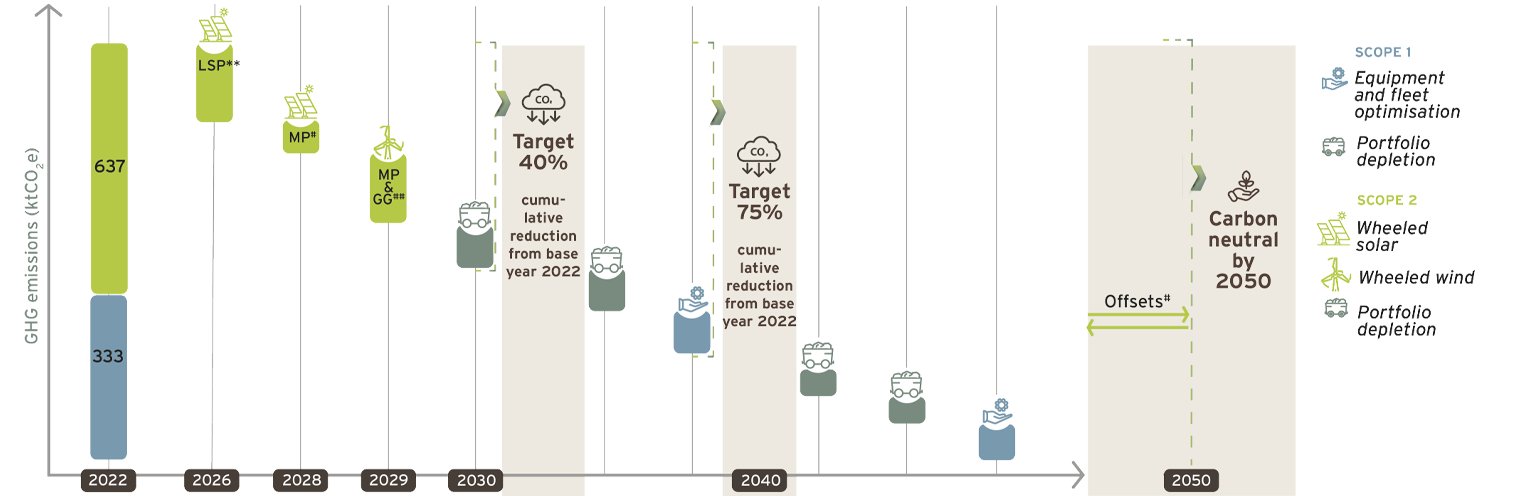
| * | Carbon offsets (nature-based and renewable) will be implemented to reach carbon neutrality by 2050. |
| * * | LSP (wheeled solar at Grootegeluk). |
| # | Wheeled solar in Mpumalanga (Belfast, Mafube and Matla). |
| ## | Wheeled wind in Belfast, Mafube, Matla and Grootegeluk. |
The roadmap directs BUs on how to plan operations, integrate renewable energy and implement efficiency measures to reduce scope 1 and 2 emissions. We prioritise high-impact efficiency projects through collaboration between our engineering teams and various stakeholders.
We classify our emissions as follows:
We reduce our diesel consumption through a phased fleet optimisation programme centred on hybrid technologies and fleet electrification.
At Grootegeluk, which accounts for 61% of total group diesel emissions, we are implementing optimisation solutions that address the logistics and equipment factors that drive lower carbon intensity through:
In 2025, we completed a desktop decarbonisation technology study that assessed fleet optimisation solutions and identified options with business case potential.
Going forward, technology selection will be based on site-specific operating data and alignment with industry OEM development pathways. Implementation will be integrated into each business unit’s rebuild or replacement cycle, taking into account technology readiness and governance requirements.
| Timeframe | Description | |
| 2026 to 2030 |
|
2031 to 2040 |
|
| 2041 to 2050 |
|
Quick wins also include energy and water efficiency programmes (linked to performance incentives), and honing our compliance focus on the pollution prevention plans for operations.
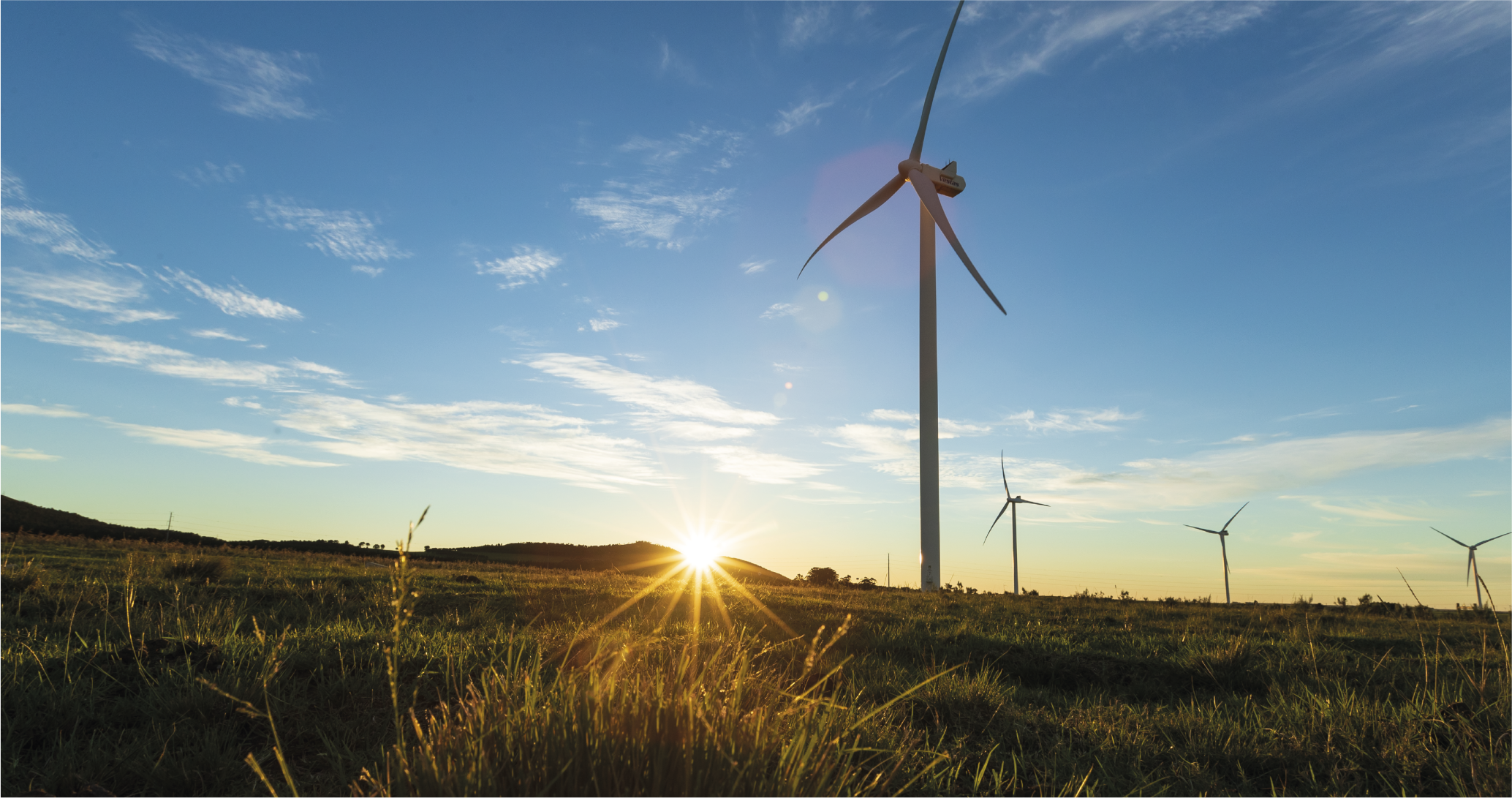
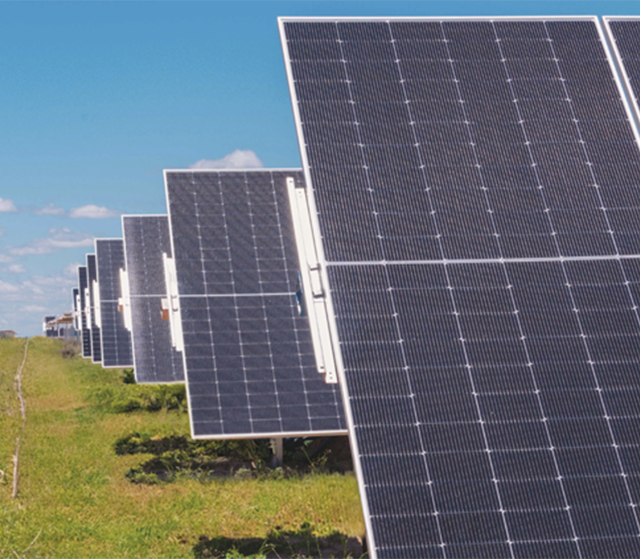
We are reducing coal-based electricity consumption by integrating renewable energy solutions across our operations. Our approach includes on-site solar generation where feasible, with solar photovoltaic (PV) projects at Tshikondeni and Grootegeluk, as well as wheeled renewable power solutions.
| Timeframe | Description | |
| 2026: Initial solar energy replacement | The LSP at Grootegeluk is supplying renewable electricity to replace a portion of coal-fired power use. Full commercial operations (68MW) is expected in 2026. The plant was commissioned in December 2025 and will contribute to a 25% reduction in scope 2 emissions at the mine. | 2027: Multi-site wheeled solar energy | Wheeled solar (approximately 50MW) is planned across multiple sites, including Matla, Belfast and Mafube, reducing reliance on grid-supplied coal-based power. |
| 2029: Multi-site wheeled wind energy | Additional wheeled wind capacity (approximately 120MW) planned for Matla, Belfast, Mafube and Grootegeluk to further reduce scope 2 emissions. | |
The LSP and future investments in decarbonising Exxaro’s mining operations represent a systematic and responsible approach to the energy transition without introducing additional risks to South Africa’s electricity generation.
In May 2025, Exxaro announced the acquisition of select manganese assets in the Kalahari Manganese Field in the Northern Cape. Manganese is essential in steel-making and is increasingly important in battery and renewable energy technologies, making it a key mineral in South Africa’s industrial and energy transition.
The acquisition strengthens the resilience of our portfolio and supports our ambition to grow revenue from energy transition metals. It also ensures that these strategic assets remain under South African stewardship, supporting continuity for employees and host communities.
The acquisition, concluded post-year end, aligns directly with our Sustainable Growth and Impact strategy by diversifying earnings, reducing reliance on coal and positioning the business to participate in long-term growth markets linked to the global energy transition.
While reducing our direct scope 1 and 2 emissions remains a priority, most of our total emissions footprint sits in scope 3. Indirect emissions occur when the coal we sell is further processed or combusted by our customers and are the largest contributor to our total GHG footprint. Addressing these emissions requires coordinated action across the value chain, particularly with large partners whose operational activities are closely linked to our products.
We are pursuing strategic partnerships with key value chain stakeholders to support shared decarbonisation ambitions, improve data transparency and explore lower-carbon pathways. These partnerships are formalised through MoUs that commit parties to jointly identify and implement emissions reduction initiatives.
In 2025, we signed an MoU with Eskom to explore opportunities to address and improve transparency around value chain emissions, identify opportunities to reduce them and contribute to an impactful transition in South Africa. This includes collaboration on inbound and outbound logistics, green procurement practices and research into lower-carbon technologies. We also support lower carbon development through our transition metals portfolio and the growth of our energy solutions business.
We are reviewing our scope 3 calculation methodologies and will develop and publish a methodology report that outlines how we quantify and disclose scope 3 emissions.
Carbon emissions reduction
Impactful transition
We report on our energy and carbon data in terms of the GHG Protocol and participate in the CDP climate change and water programmes.
We adopt nature-based solutions that enable biodiversity protection and restoration, positively contribute to our broader social impact and include benefits such as carbon offsetting and credits.
Additional carbon offset opportunities across our operations are being assessed and will be guided by the carbon offset strategy. Work to establish a clear, evidence-based approach for quantifying and verifying sequestration from nature-based projects is still to be developed and will form part of the next phase of implementation.
We follow a leadership-driven process and provide decarbonisation training to enable employee participation.

2026
Key actions
Our focus for 2026 is to consolidate progress made during the year and integrate newly acquired assets into our operational model and corporate culture. This includes: