
Exxaro Resources Limited
Environmental, social and governance report for the year ended 31 December 2025


Many of our operations are located in rural areas where economic activity outside of mining is limited and unemployment, particularly among youth, is high. Without deliberate intervention, mine closure can intensify social vulnerability and erode local livelihoods.
Through the MSP, we convert rehabilitated or unused mining land into productive agricultural assets that support enterprise development and sustainable income generation, contributing to an impactful transition, inclusive growth and long-term community wellbeing.
SERC
Oversees the integration of post-mining planning into operations and monitors programme performance
The executive head: sustainability monitors land use management and the implementation of the Social Impact strategy
The stakeholder relations function coordinates land access, farmer support and stakeholder partnerships at operation level
We aim to effectively develop emerging black farmers, transforming them from subsistence to commercial farmers by enabling access to land, resources and market opportunities. Our partnership-focused approach enables Exxaro to provide structured support that positions participants for long-term success within the agricultural value chain.
Key elements of our approach include:
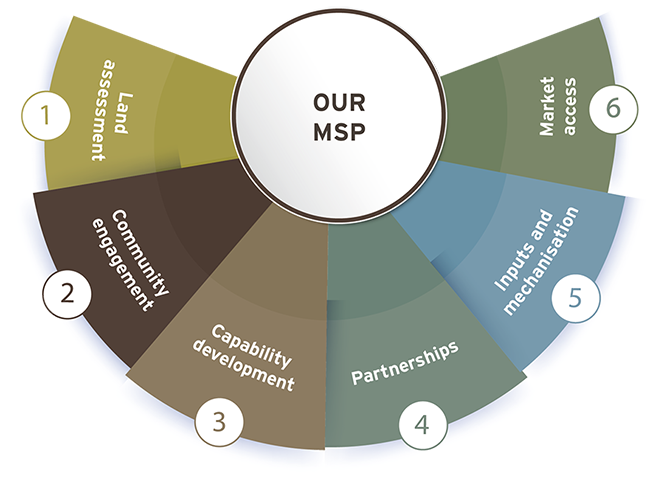
Determine land feasibility and optimal agricultural use through structured analysis.
Identify high-potential emerging farmers through local engagement and profiling.
Provide farmer training, technical support and business planning assistance.
Work with funders, agri‑specialists and implementing partners to strengthen delivery.
Facilitate access to seeds, fertilisers, equipment and production essentials.
Secure offtake agreements and connect farmers to reliable markets.
We strengthen post-mining economic resilience by providing integrated support that enables emerging farmers to operate independent, commercially viable agri-enterprises. We provide farmers with tailored support that covers foundational and advanced requirements across the agricultural value chain. This includes access to rehabilitated or unused mining land, essential inputs and mechanisation, and technical guidance on crop and livestock production. Farmers receive training in production best practices, compliance readiness (including Global GAP and other requirements) and enterprise management. We also help farmers develop business plans, financial models and funding applications.
We work with development finance institutions to raise funding for farmers, secure land leases and facilitate access to resources. In addition, partnerships with agri-specialists and offtake partners help ensure that participating farmers can meet market standards and secure reliable buyers. These collaborations enhance the MSP’s reach and enable farmers to progress from inception to commercial maturity.
We track several indicators to ensure that our interventions deliver community benefits and progress farmers towards independence.
Key measures include:
We also track funding deployed through Exxaro’s instruments and additional capital leveraged from development finance institutions.
| Number of projects | Number of farmers | |||||
| Province | Type of farming | 2025 | 2024 | 2025 | 2024 | |
| Limpopo | Crops | 4 | 4 | 13 | 230 | |
| Mpumalanga | Livestock, grain, fruit and poultry | 13 | 13 | 31 | 32 | |
| Gauteng | Essential oils | 1 | 1 | 1 | 1 | |
| KwaZulu-Natal | Livestock, grain, forestry and essential oils | 15 | 15 | 90 | 297 | |
| Western Cape | Honey | 1 | 1 | 1 | 1 | |
| Eastern Cape | Livestock | 2 | 2 | 2 | 2 | |
| Total | 36 | 36 | 138 | 662 | ||
Due to capacity and funding challenges, the number of farmers receiving support through the MSP decreased compared to last year. We are exploring alternative funding sources for farmers currently not receiving support. However, farmers who graduate from the MSP will be replaced from the pool of farmers that has been scoped and baselined. The number of supported farmers will therefore always be at least 138.
The MSP has 10 662.5ha under management. At year end, we supported 138 farmers across 36 projects in six provinces (2024: 662 farmers).
We did not enter into new leases during 2025, as the focus for the year was on deepening the quality and effectiveness of support within existing projects. This deliberate consolidation enables stronger engagement, deeper farmer capacity building and greater impact at farm level.
Additional projects will be introduced as current participants mature through the programme and demonstrate readiness for graduation.
In 2025, farmers made gradual progress toward greater independence through training, mentorship and production support. Several projects, however, required additional assistance.
Farmers used the additional funding for soil preparation and input costs.
Crop performance was impacted by adverse climate conditions and late planting in 2025, leading many farmers to fall short of expected yields. The reduced harvest volumes also influenced seasonal job creation, which depends heavily on cropping cycles. Several farmers will require additional technical and financial support in the next planting season, particularly where loans were tied to current season output.
| * | The funding includes the technical, non-financial support provided to the farmers |

2026
key actions
Our focus for 2026 is to strengthen agricultural resilience, secure additional funding partnerships and pilot alternative post-mining land uses. We aim to do this by: