Exxaro Resources Limited
Environmental, social and governance report for the year ended 31 December 2025


Mining activities such as drilling, blasting, hauling and materials handling can release dust and gaseous emissions that affect air quality and pose health and environmental risks to employees, host communities and surrounding ecosystems. Regulators and communities expect us to maintain air quality within prescribed limits and respond proactively to potential exceedances.
Strong air quality management supports our Climate Change Response and Sustainable Growth and Impact strategies by promoting safe, compliant and responsible operations.
SERC and RBR committee
Oversees implementation and monitoring of air quality initiatives and dust suppression technologies
The executive head: sustainability approves air quality policies, procedures and mechanisms
Mine managers and BU specialists compile site-specific dust management plans, allocate capital and oversee monitoring and mitigation measures
We manage air quality through a proactive, risk-based approach that prioritises prevention, monitoring and continuous improvement across all operations. Our aim is to limit pollution from dust fallout, ensure compliance with regulations and use technology to enhance control, performance and reporting.
Key elements of our approach include:
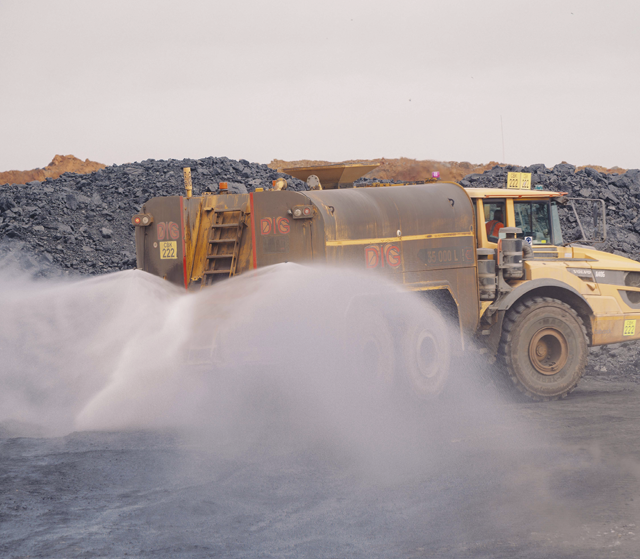
Our air quality management measures focus on progressively reducing the occupational emissions associated with open-pit mining, which include dust and PM, sulphur oxides and nitrogen oxides. If not adequately managed, these can have a negative impact on ambient air quality, which in turn impacts the health of people and local ecosystems.
Our dust suppression and control measures are designed around health, safety and environmental considerations, and include:
We intensify our dust management efforts during the dry winter months given the proximity of some operations to residential areas.
We are implementing environmentally friendly wet suppression technologies to limit chemical use and optimise water use. Matla introduced an automated fogging system with continuous real-time dust monitoring, while Leeuwpan uses Suppress-It as its primary dust suppression solution.
We monitor air quality through an extensive network of dust fallout buckets and meteorological stations across all operations. We also have PM10 sensors at Grootegeluk. These systems provide baseline data, support dispersion modelling and enable real-time reporting to internal and external stakeholders.
BUs follow defined procedures for measurement, mitigation and reporting, including response protocols for exceedances. We submit quantitative data to the National Atmospheric Emissions Inventory System in line with the National Environmental Management: Air Quality Act. We review results quarterly to identify trends and prioritise areas needing intervention.
Exxaro also contributes data to government monitoring in the highly industrialised Highveld and Waterberg-Bojanala areas, helping track cumulative regional impacts. We are actively aligning with the upcoming regulations for implementing and enforcing priority area air quality management plans for these regions, which propose expanded monitoring requirements, stricter compliance measures and measurable reduction targets for identified industries, including mining.
We regularly evaluate and expand dust management plans and monitoring networks to maintain 100% coverage across all operations and improve data granularity.
Advanced monitoring technology underpins real-time emissions monitoring. The multi-pollutant ambient monitoring station at Grootegeluk (Manketti game reserve) provides continuous real-time measurement of a wide range of emissions, including PM10,PM2.5 and sulphur dioxide (SO2). Additionally, a low-cost station at Elandsbosch farm measures SO2 and hydrogen sulphide (H2S).
The system enables faster operational response and contributes to collective research and management efforts in the Waterberg-Bojanala priority area. Service-level agreements ensure regular calibration, maintenance and data integrity.
We conduct awareness campaigns in host communities and across operations to promote an understanding of air quality impacts and dust mitigation practices. We host feedback sessions to promote responsible behaviour among employees and contractors, and give communities the opportunity to review monitoring results and discuss local interventions.
We collaborate with the Coaltech Research Association, the National Association for Clean Air and various government departments to advance national air quality standards, align with evolving regulatory expectations and improve emission quantification methods, particularly for dust from discard dumps.
Engagement with service providers encourages the testing and adoption of innovative technologies through pilot projects.
In addition, we continue to engage local suppliers through our ESD programme to build long-term capacity in dust suppression and environmental management. The Lubocon Dust Suppression Project JV, which grew through our ESD programme, remains an example of how collaboration with local partners can combine environmental stewardship with socio‑economic development.
In April 2025, we signed an MoU with Eskom to collaborate on research and projects that address air quality challenges and reduce carbon emissions. The partnership builds on our shared commitment to operational sustainability, environmental stewardship and national air quality objectives.
Identifying and testing alternative, cost-effective technologies to reduce SO2 and particulate emissions associated with power generation and coal supply.
Early work includes the joint assessment of flue gas desulphurisation technologies for Eskom’s Medupi power station, as well as opportunities to improve emission controls and data monitoring across the coal value chain.
Initiatives support compliance with future national emission standards and help mitigate cumulative air quality impacts in the Waterberg-Bojanala and Highveld priority areas.
Through this collaboration, we aim to strengthen technical knowledge and support innovation in emission reduction technologies. The partnership also reflects our commitment to transparent data sharing and stakeholder engagement to ensure measurable progress in air quality management. By aligning research and operational expertise, Exxaro and Eskom are working to advance sustainable solutions that protect communities, sustain energy security and promote responsible resource use.

| Maximum allowance | Limits | Highest recorded | ||||
| 2025 | 2024 | 2023 | ||||
| Non-residential dust fallout exceedances | Two exceedances per BU per year (not occurring in sequential months) | 1 200mg/m2/day |
2(Grootegeluk) 1(Leeuwpan) |
1(Matla) 2(Belfast) |
1 (Matla) | |
| Residential dust fallout exceedances | Two exceedances per BU per year (not occurring in sequential months) | 600mg/m2/day | 0 | 0 | 2 (Matla) | |
Monitoring and mitigation measures remained effective during 2025. Overall performance remained within regulated limits, with two isolated exceedances at Grootegeluk in March and August, and one exceedance at Leeuwpan in September. These exceedances were observed as a result of land clearing activities occurring in close proximity to the sampling bucket position. The incidents were investigated and no consecutive exceedances occurred.
| 2025 | |||
| Pollutant | SO2 (ppb) | PM2.5 (μg/m3) | PM10 (μg/m3) |
| Annual National Ambient Air Quality Standards limits (24-hour) | 48 | 40 | 75 |
| Annual average (24-hour) | 13.48 | 4 | 24.47 |
The source of these emissions is Exxaro’s mining operations, including material handling, haulage activities and associated operational processes. We monitor ambient air quality impacts at locations within operational and nearby residential environments. We calculate the emissions using continuous, real-time ambient air quality monitoring in line with South Africa’s National Ambient Air Quality Standards, using US Environmental Protection Agency and EU-approved analysers and low-cost electrochemical sensors.

2026
key actions
Our focus for 2026 is to embed the improvements made during 2025, enhance regulatory readiness and expand real-time monitoring and awareness initiatives across our operations and host communities. This includes: