
Exxaro Resources Limited
Environmental, social and governance report for the year ended 31 December 2025


Our remuneration policy is underpinned by our philosophy of fostering a high-performance culture while ensuring fairness and competitiveness. The policy aims to attract, motivate and retain talent by aligning employee rewards with our strategic objectives, core values and commitment to creating lasting value for all stakeholders.
Our remuneration framework supports the delivery of sustained organisational performance across multiple dimensions. It reinforces business stability through periods of change, enables leadership continuity and bench strength, and promotes alignment between strategy, organisational structure and execution. The framework further supports the embedding of a high-performance and ethical culture, with a strong emphasis on accountability, safety and disciplined delivery of strategic priorities.
Our policy is rooted in robust governance practices and reflects our commitment to fair, equitable and responsible remuneration. It integrates ESG priorities to drive sustainable impact and aligns remuneration outcomes with both short-term performance and long-term value creation. By balancing guaranteed pay, benefits, variable pay and recognition, the policy ensures that individual contributions support Exxaro’s strategic objectives, while advancing diversity, equity and inclusion as well as operational excellence.



We recognise that people’s value is more than monetary reward. Our approach therefore integrates all reward elements to create a total reward. The cornerstones of our approach are competitive reward and pay for performance. These are set out in detail below.
We also emphasise recognition through the Exxaro Evergreen Awards, acknowledging individual and team delivery in meeting business goals and reinforcing behaviours aligned with Exxaro’s values, culture and leadership principles.
Total reward includes guaranteed pay and variable pay, comprising STIs, LTIs and recognition schemes. Other integrated intangible reward and benefit elements include:

We pay competitive salaries, rewarding individuals based on their skills, performance and external market positioning.
Our total reward framework is underpinned by our commitment to fair, equitable and responsible pay. By applying the principle of equal remuneration for work of equal value, we seek to eliminate discriminatory remuneration – whether direct or indirect – based on race, gender, age, disability, gender identity and expression, sexual orientation, ethnicity, cultural heritage, religion or belief.
We review our internal pay ranges annually and apply them consistently throughout the organisation. Our commitment to fair pay is consistent with our DEI strategy, culture and desire to support, motivate and engage employees across the group.
We review our fair pay principles and their application annually.
During the annual salary review process, we review each employee’s ideal comparative ratio and adjust this in line with our principles. The fair pay analysis focuses on market competitiveness, non-discrimination and performance over a three-year period. The outcome of the fair pay analysis for the 2025 financial year shows that all Exxaro employees’ remuneration is aligned with our fair pay principles.
The wage gap is a crucial issue in South Africa, which is characterised by extreme inequality, poverty and unemployment. Our wage gap and fair pay principles aim to address this issue and are rooted in our values and group remuneration principles: consistent, fair, equitable and market-related remuneration.
Fair pay is foundational and an enabler for DEI, which is a strategic priority at Exxaro. It is our ethical responsibility to address inequality and wage gaps horizontally between race and gender and vertically between lower-paid employees and executives.
The following principles reflect our priorities:
Exxaro is committed to our purpose of powering better lives in Africa and beyond. Guided by our DEI objectives, we strive to deliver on our commitment to fair and responsible pay and effective remuneration practices, which ensure Exxaro’s sustainability for all our stakeholders.
In line with our values – empowered to grow and contribute, teamwork, commitment to excellence and honest responsibility – we will demonstrate our commitment by disclosing the wage gap between our highest and lowest paid employees in the prescribed manner. To do this, we review and develop measures to ensure fair and responsible pay and comply with regulatory requirements and generally accepted remuneration practices while considering the needs and legitimate expectations of all stakeholders.
We aim to integrate stakeholder input and align with responsible industry movements as we continue our fair pay-for-performance journey.

We continue strengthening Exxaro’s wage gap governance and analytical capability as part of our broader fair and responsible pay agenda. Our initiatives for 2026 include:
We will continue to monitor both vertical and horizontal wage gap measures using the established 5:5 methodology, supported by independent analysis. These analytics enable us to monitor trends in remuneration outcomes across levels and demographic groups and support informed decision making by the remuneration committee.
The Companies Amendment Act introduces new disclosure requirements relating to wage gap reporting. During 2026 we will continue to refine our analytical and governance framework to ensure that Exxaro remains well positioned to comply with these requirements once the final regulatory framework and implementation timelines are confirmed.
During 2025 Exxaro joined the Living Wage South Africa Network, enabling the group to participate in national research and dialogue on credible living wage benchmarks. The Network’s R15 000 net monthly benchmark is currently used as an external contextual reference, rather than a formal policy threshold, recognising that further research is required to develop a consistent methodology for converting employer-funded benefits into a comparable living wage measure.
We will continue to assess remuneration outcomes holistically, considering both guaranteed pay and employer-funded benefits such as medical aid, retirement contributions and other protections that form part of our total reward offering. This approach ensures that fair pay considerations reflect the full value of remuneration provided to employees.
Through these initiatives, Exxaro aims to maintain a principled, transparent and data-driven approach to fair and responsible remuneration while supporting the long-term sustainability of the group and the wellbeing of our employees.
We remain dedicated to reducing the wage gap through our targeted projects and remuneration adjustments. We also strive to adhere to industry best practices and relevant governance codes, such as King IV.
During the year, the remuneration committee reviewed several elements of Exxaro’s remuneration framework to ensure continued alignment with the company’s strategy, shareholder expectations and evolving governance practices.
The following key refinements were approved:
The committee approved the replacement of the DBP with a DBS scheme. The DBS structure simplifies the previous matching share arrangement by removing the requirement for employee co-investment and introducing a deferral mechanism that is directly linked to the outcome of the GIS. The change aligns Exxaro’s incentive framework with emerging market practice and shareholder preferences for bonus deferral structures.
The LTIP performance conditions were refined to better reflect Exxaro’s evolving portfolio and strategic priorities. The ESG measure, FTSE Russell Index, was replaced with operationally measurable sustainability targets, including decarbonisation and rehabilitation performance measures. In addition, refinements were made to the TSR peer group and ROCE calibration.
The malus and clawback policy was updated to strengthen governance oversight of incentive outcomes. The updated policy clarifies the circumstances in which malus and clawback may be applied and extends the scope of the policy to a broader group of participants across the company’s variable remuneration schemes.
The remuneration committee exercised its discretion under the MSR policy to align the CEO’s MSR with the CEO’s three-year fixed-term contract. The requirement will therefore apply on a proportionate basis during the contractual period. This arrangement is intended as an interim measure pending the broader MSR policy review planned for 2026.
As part of Exxaro’s employee value proposition, annual leave for management and specialist employees will increase from 15 to 17 working days with effect from 2026. This enhancement has been incorporated within the overall remuneration framework and was funded within the normal annual remuneration allocation process.
| Remuneration element | Objective | Eligibility | Application |
| Total guaranteed pay includes all guaranteed items, such as basic salary, medical aid, pension fund and guaranteed allowances | To attract and retain the right mix of talent with market-related pay, reflecting the size, scope and complexity of individual roles and responsibilities | All permanent employees |
|
| Employee benefits and allowances | To provide relevant benefits to meet employees’ needs and aspirations and improve our overall employee value proposition | All permanent employees |
|
| STIs | To drive a high-performance culture that motivates and rewards substantial achievement of shortterm business and individual targets | All employees with payout levels differentiated by job grade and performance contribution |
|
| LTIs | To drive sustainable, longer-term performance and encourage ownership and retention by aligning the interests of senior employees and executives to those of Exxaro and its shareholders | Middle management employees and above | The Exxaro LTI scheme is made up of the LTIP scheme:
For Cennergi, the LTI scheme is made up of the VARP scheme:
|
| ESOP | To foster a sense of participation in the company’s success by aligning with shareholder outcomes | Junior management and below | Paid twice a year as an amount equivalent to the dividend paid on 560 Exxaro shares |
| Recognition | To celebrate exceptional contributions, foster a culture of appreciation and honour loyalty | All employees | For formal recognition, employees are encouraged to nominate themselves or their colleagues for acknowledgement at various levels for an award. For informal or day-to-day recognition, line managers and peers are encouraged to recognise discretionary effort without waiting for a formal recognition opportunity |
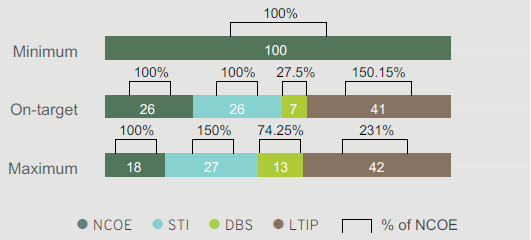
The remuneration mix reflects the relative proportions of pay, represented by guaranteed and variable remuneration, meaningfully linked to job type, level of work and expected outcomes.
CEO pay mix (%)
Prescribed officer (on Paterson band E – upper) pay mix (%)
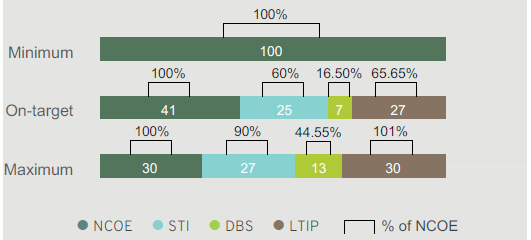
FD pay mix (%)
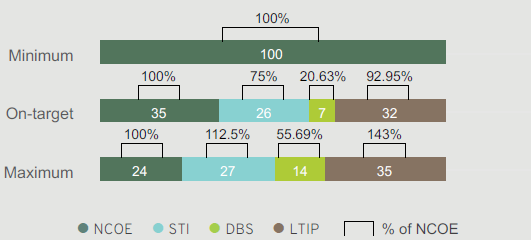
Prescribed officer (on Paterson band E – middle) pay mix (%)
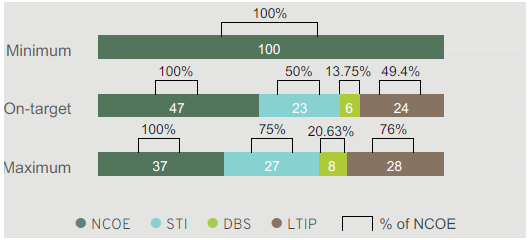
Prescribed officer (on Paterson band F – lower) pay mix (%)
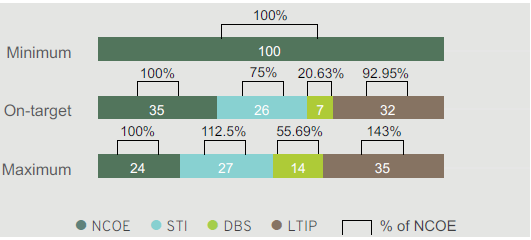
MD energy (on Paterson band F – lower) pay mix (%)
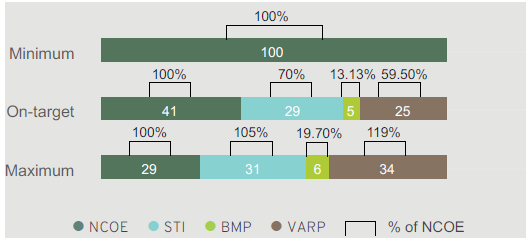
Our policy on fixed pay is to benchmark annually using established industry remuneration surveys to the median for all employees except the strategic, scarce and critical skills, which may be benchmarked to the 75th percentile.
We consider individual performance when setting fixed pay through the annual NCOE salary review process – a “meets expectations” warrants positioning around the median of the benchmark for the job.
All bargaining unit employees receive a market-related basic salary, complemented by guaranteed allowances (housing and commuting), variable allowances (shift and standby) and benefits (listed alongside).
All employees are entitled to the same benefits appropriate to their role and specific circumstances. Management and specialist employees can structure their remuneration within company and legislative limitations. As part of enhancing Exxaro’s employee value proposition and aligning with market practice, annual leave for management and specialist employees will increase from 15 to 17 working days with effect from 2026. The introduction of this enhanced leave benefit formed part of the annual remuneration review process. During the year, the medical, health and other benefits policies did not change. Medical aid scheme details are described alongside.
All employees are members of one of Exxaro’s accredited retirement funds. Retirement fund contributions are determined by specific conditions of employment and for different employee levels and categories.
Employees may annually choose to belong to any employer-accredited and applicable medical schemes. The employer and employee make contributions. Exxaro does not provide post-retirement medical benefits. The post-retirement benefit obligation, disclosed in the annual financial statements, recognises past practice by Eyesizwe, which was discontinued with the creation of Exxaro in November 2006.
Employees are beneficiaries of a policy that provides additional cover for death, disability and dread disease through group personal cover taken out by Exxaro.
As part of our wellness offering, the employee assistance programme offers wide-ranging support, including legal, financial and substance abuse assistance, among others.
Our STI schemes focus on annually contributing to strategic goals and delivering on our operational and financial objectives in the shorter term. We have two STI scheme structures: the GIS for management and specialist category employees and the line of sight for other permanent employees, which are specific production schemes relevant to employees’ positions.
GIS salient features
| Participants |
|
|
| Scheme metrics and frequency of payment |
|
|
| Apportionment |
|
|
| Maximum achievable | 150% of targeted STI quantum | |
| Gatekeepers | When the personal score is below a 3.0 rating, the percentage score modifies respective business performance outcomes, further reducing the STI portion from business performance | |
| Business scorecard | Detailed below | |
The business scorecards embed priorities appropriately at group and operational levels. The table below provides an overview of the goals and relative impact on the potential outcome of each business scorecard.
GIS business scorecard goals and weight
| Weight (%) |
Drivers | Group (%) |
Operation (%) |
|||||||
| Overall structure | Financial, operational and strategic | 75 | EBITDA | 50 | 0 to 50 | |||||
| Cash cost per tonne | 15 | 15 to 45 | ||||||||
| Saleable tonnes | 10 | 10 to 30 | ||||||||
| ESG: safety and climate change | 25 | Safety | 10 | 10 | ||||||
| Water intensity | 7.5 | 7.5 | ||||||||
| Energy intensity | 7.5 | 7.5 | ||||||||
| Overall scorecard total | 100 | 100 | ||||||||
The DBS scheme forms part of Exxaro’s incentive framework and supports the alignment of executive remuneration with long-term shareholder value creation.
From the 2026 remuneration cycle, the DBS scheme replaces the previous DBP. The DBP historically allowed eligible employees to voluntarily invest a portion of their after-tax GIS bonus into Exxaro shares, with the company providing matching shares after a three-year holding period. While the DBP supported share ownership and retention, the structure required employee co-investment and was dependent on the availability of post-tax cash.
Following a review of the incentive framework and engagement with institutional investors, the board approved the introduction of the DBS scheme, which replaces the DBP and simplifies the deferral structure while maintaining alignment with performance outcomes.
Key features of the DBS scheme
Under the DBS structure:
Because the DBS award is determined with reference to the GIS outcome, the same business and individual performance conditions that determine the GIS cash portion of the bonus also determine the value of the DBS award. Where the GIS cash portion of the bonus is reduced due to lower performance outcomes, the DBS award reduces proportionately. Where no GIS bonus is earned, no DBS award is granted.
The introduction of the DBS scheme strengthens Exxaro’s remuneration framework by:
Importantly, the DBS structure replaces the economic value previously delivered through DBP matching shares and therefore represents a structural refinement of the incentive framework and does not increase overall remuneration or cost to the company.
Eligibility
The DBS scheme applies to employees at executive and senior management levels, consistent with the eligibility criteria previously applied under the DBP.
The Cennergi STI scheme is the BMP, which focuses on annually contributing to strategic goals and delivering on our operational and financial objectives in the shorter term.
BMP salient features
| Participants |
|
|
| Scheme metrics and frequency of payment |
|
|
| Apportionment |
|
|
| Maximum achievable |
|
|
| Business scorecard |
|
|
BMP business scorecard goals and weight
| KPIs | Weight (%) | |
| Strategy development | 10 | |
| Financial performance and internal control | 10 | |
| Strategy implementation, pipeline health, new projects and services | 35 | |
| Operational and construction excellence | 25 | |
| People and social impact | 15 | |
| Health, safety and environmental | 5 | |
| Scorecard total | 100 |
Cennergi middle management and above employees receive an award of rights to Exxaro shares calculated as a predetermined percentage of the annual incentive. 50% of the award vests after 12 months and the remaining 50% after 24 months. Participants are not entitled to rights in respect of the shares until vesting takes place. No performance vesting conditions apply to the matching award.
Our LTI scheme comprises the LTIP and ESOP which align remuneration with longer-term shareholder expectations and outcomes.
We provide general share awards to participants (middle management and above) during the year in terms of the LTIP. We introduced the ESOP (GreenShare) in July 2020, which applies to employees not participating in the LTI scheme.
The LTIP aligns executive remuneration with long-term shareholder value creation and supports the delivery of Exxaro’s strategic priorities.
Awards are made annually and vest after a three-year performance period, subject to the achievement of predefined performance conditions.
From the 2026 LTIP award cycle, the performance conditions have been refined to better reflect Exxaro’s evolving portfolio and strategic priorities.
The LTIP performance conditions and weightings are as follows:
| Performance condition | Weighting (%) | |
| ROCE | 35 | |
| TSR | 35 | |
| ESG | 30 |
Performance is assessed using a sliding scale between threshold, target and stretch performance levels, with vesting outcomes determined by the remuneration committee at the end of the performance period.
ROCE condition (35%)
ROCE remains an appropriate measure of long-term financial performance given the capital-intensive nature of Exxaro’s business.
ROCE measures management’s ability to generate operating profit from the capital employed in the business and reflects the efficient allocation of capital across Exxaro’s portfolio.
The ROCE targets for the 2026 LTIP are:
The ROCE performance measure is calculated as the arithmetic average of the weighted ROCE achieved over the three-year performance period.
To reflect the evolving portfolio mix, a weighted ROCE methodology is applied which considers both the overall group ROCE and the ROCE of the mining operations excluding energy investments.
| ROCE component | Weighting (%) | |
| Exxaro group ROCE | 20 | |
| Exxaro group ROCE excluding energy | 80 |
TSR condition (35%)
The TSR measure aligns executive incentives with shareholder value creation by comparing Exxaro’s TSR with relevant peer groups.
From the 2026 LTIP awards, the TSR framework has been updated to better reflect Exxaro’s diversified portfolio.
The TSR peer group now comprises three components:
| TSR peer group | Weighting (%) | |
| JSE RESI 10 | 50 | |
| Energy peer group | 20 | |
| Coal peer group | 30 |
The coal peer group replaces the previous use of Thungela as a single comparator and includes several global coal producers to provide a broader and more representative benchmark.
Exxaro’s TSR performance is assessed relative to these peer groups using a smoothed compound annual growth rate methodology over the three-year performance period.
Vesting outcomes are determined as follows:
RESI 10 portion
| Performance | Vesting (%) | |
| Below median TSR | 0 | |
| Median TSR | 50 | |
| Top three TSR | 100 |
Energy and coal peer group portions
| Performance | Vesting (%) | |
| Below average peer TSR minus 3% | 0 | |
| Equal to average peer TSR plus 3% | 90 | |
| Average peer TSR plus 6% | 100 |
The average peer TSR for Coal and Energy is calculated as the average of the smoothed TSRs of the respective Coal and Energy peer group companies.
Linear vesting applies between these performance points.
ESG condition (30%)
The ESG performance condition has been strengthened from the 2026 LTIP awards through the replacement of the FTSE Russell ESG Index with operationally measurable sustainability targets.
The ESG measure is split equally between:
| ESG metric | Weighting (%) | |
| Decarbonisation performance | 50 | |
| Rehabilitation performance | 50 |
Decarbonisation
This measure supports Exxaro’s commitment to achieving carbon neutrality by 2050, with a target to reduce scope 1 and scope 2 emissions by 40% by 2030.
The LTIP target tracks the reduction in absolute emissions relative to the 2022 baseline, reflecting the contribution of renewable energy projects and other operational decarbonisation initiatives.
Vesting is determined using a sliding scale based on the average emissions reduction achieved over the three-year performance period.
| Performance | Vesting (%) | |
| Threshold | 50 | |
| Target | 80 | |
| Stretch | 100 |
Rehabilitation
Rehabilitation performance measures the achievement of planned backfill volumes across Exxaro’s opencast operations.
Concurrent rehabilitation is a key mechanism for reducing long-term environmental liabilities and forms an important component of Exxaro’s responsible mining practices.
Vesting is determined using a sliding scale based on the deviation from budgeted rehabilitation targets over the performance period.
| Performance | Vesting (%) | |
| Threshold | 50 | |
| Target | 80 | |
| Stretch | 100 |
Our ESOP scheme, GreenShare, was implemented in 2020. It is broadly based on the principles of Mining Charter III and is an evergreen scheme that provides non-transferable carried interest (dividends) to qualifying employees. It is open to all permanent South African employees not participating in any management share scheme, and it does not carry risks for employees.
When dividends are declared, employees in service receive an amount equivalent to the dividend paid on 560 Exxaro shares, minus dividend withholding tax.
Employees remain in the scheme for the duration of their employment and do not have capital appreciation rights.
The Cennergi LTI offering comprises:
The VARP is a cash-based LTI. Participants are awarded a once-off bullet award at the start of the performance period. The award is calculated as a percentage of the participant’s NCOE multiplied by an award multiple linked to the duration of the award. The award vests in three equal tranches (in years three, four and five) subject to achieving predetermined milestones. After vesting, participants have four years to exercise the award.
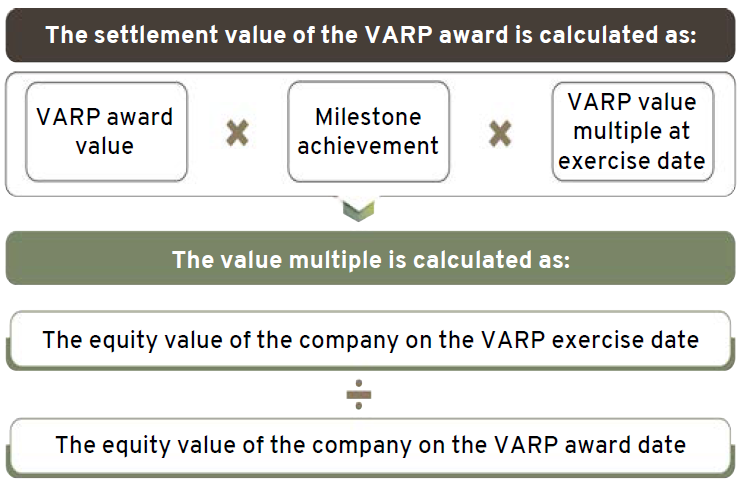
VARP milestones
The 2026 to 2030 milestones will focus on achieving a targeted cumulative net MW generating capacity.
| Vesting profile (MW) | 2026 | 2027 | 2028 | 2029 | 2030 |
| Threshold (30% vesting) | 326 | 406 | 475 | 567 | 692 |
| Stretch (100% vesting) | 413 | 612 | 840 | 1 148 | 1 563 |
All these awards would be made for strategic purposes on an exception basis and are considered a strategic tool that the committee can use if the circumstances require, rather than being part of standard or expected practice.
The committee also ensures that with these awards, it applies performance conditions and malus and clawback provisions.
In line with global governance practices and shareholder expectations, Exxaro adopted an MSR policy in 2021. The policy encourages executive directors and prescribed officers to build and maintain a meaningful shareholding in the company in order to reinforce alignment between executive leadership and shareholder interests.
The MSR requires executives to accumulate and hold shares in Exxaro equivalent to a multiple of their NCOE. The minimum shareholding levels are as follows:
| Role | MSR | Compliance period |
| CEO | 2 x annual NCOE | Five years from the date of policy implementation (or from appointment as a prescribed officer if later) |
| FD | 1.5 x annual NCOE | |
| Other prescribed officers | 1 x annual NCOE |
Executives are expected to achieve the required shareholding within five years from the date of policy implementation or from appointment as a prescribed officer, whichever is later.
Shares that may count towards the MSR include:
These provisions encourage executives to maintain a meaningful level of personal investment in the company and support long-term alignment with shareholders.
The current CEO is appointed on a three-year fixed-term contract, which creates a structural misalignment between the CEO’s contractual tenure and the standard five-year MSR determination period.
Following consideration of this matter, the remuneration committee exercised its discretion under the MSR policy to align the determination period with the CEO’s contractual term and to apply the MSR target on a proportionate basis. Accordingly, the CEO is required to accumulate a minimum shareholding equal to 120% of NCOE over the three-year contract period, reflecting the equivalent annual accumulation rate of the standard MSR requirement. This approach maintains the principle of alignment between executive leadership and shareholders while recognising the practical constraints associated with the CEO’s contractual tenure.
The proportional MSR requirement is intended as an interim arrangement, pending the broader review of the MSR policy scheduled for 2026 and any future nomination committee and board determinations regarding the CEO’s contractual tenure.
As part of this review, the remuneration committee will consider whether any refinements to the policy are appropriate in light of evolving governance practices and shareholder expectations.
Exxaro maintains a malus and clawback policy to reinforce accountability and strengthen the link between remuneration outcomes and responsible conduct. During 2025, the remuneration committee approved updates to the malus and clawback policy to further strengthen governance, align with evolving market practice and shareholder expectations. The updated policy expands the scope of application and clarifies the circumstances under which malus and clawback provisions may be applied.
Malus applies to unvested variable remuneration, including deferred incentives and LTI awards. Where a trigger event occurs during the vesting period, the remuneration committee may reduce or cancel the unvested portion of the award.
Clawback applies to variable remuneration that has already vested, settled or paid. Where a trigger event occurs after payment or vesting, the company may seek to recover the value of the remuneration received. Clawback will be applicable for up to 36 months from the vesting date.
As part of the policy update, the scope of the malus and clawback provisions was extended to apply to a broader group of participants, including employees participating in the DBS scheme and the LTIP, in addition to employees participating in the GIS.
Trigger events that may result in the application of malus or clawback include:
The remuneration committee retains discretion to determine the appropriate application of malus or clawback, taking into account the circumstances of the event and principles of fairness and proportionality.
These provisions apply to remuneration outcomes disclosed in the implementation report, and any material application of malus or clawback will be disclosed to shareholders.
These enhancements strengthen accountability and reinforce the link between reward, conduct and risk outcomes, ensuring that remuneration remains aligned with the group’s values and governance expectations.
The remuneration committee maintains robust governance and oversight mechanisms for executive appointments and contracts, ensuring alignment with the company’s strategic priorities and governance principles.
Executive employment contracts are generally valid until the normal retirement age of 63. The notice period for the CEO is six calendar months. The notice period for the FD and prescribed officers is three calendar months. Current executive employment contracts do not have a restraint-of-trade clause but include confidentiality undertakings.
Any shares due in terms of participating in the LTIP and DBP/DBS are paid in line with the schemes’ rules.
The committee retains the discretion to exercise judgement in interpreting, applying and implementing the remuneration policy to ensure fairness, alignment with business objectives and adherence to good governance principles. Discretion may be applied in exceptional circumstances or where strict adherence to the policy would result in outcomes that are misaligned with the company’s values, strategy, or stakeholder expectations.
Key principles guiding the exercise of the remuneration committee’s discretion include:
| Fairness and equity | Ensuring that decisions are fair, consistent and equitable for all employees | |
| Alignment with strategic objectives | Maintaining alignment between remuneration outcomes and achieving Exxaro’s strategic priorities | |
| Governance and compliance | Upholding high standards of corporate governance and compliance with applicable laws and regulations | |
The remuneration committee’s discretionary authority may include, among others:
All the committee’s discretionary decisions will be transparently documented and disclosed, where appropriate, to relevant stakeholders to ensure accountability and trust.
We conduct a comprehensive review of non-executive director fees on a three-year cycle, benchmarking against a chosen peer group. This ensures that our remuneration framework remains competitive and aligned with best practices.
Our approach positions non-executive director fees at the median of the chosen peer group, reflecting Exxaro’s scale, complexity and industry standing. In years where an external benchmarking exercise is not undertaken, adjustments to non-executive director fees are aligned with the approved annual increases for management and specialist category employees.
The remuneration committee carefully evaluates and recommends non-executive director fees, which are subsequently reviewed by the board. Final approval is sought through a special resolution at the company’s AGM, with implementation effective from June.