
Exxaro Resources Limited
Environmental, social and governance report for the year ended 31 December 2025


ESD is central to strengthening inclusive economic growth in our host communities. Stakeholders expect us to enable opportunities for small businesses, create jobs and support meaningful participation in regional value chains. Effective ESD also strengthens supply chain resilience and supports the transformation objectives that underpin our social licence to operate.
This contributes directly to our Sustainable Growth and Impact strategy by empowering communities to build sustainable livelihoods beyond mining and supporting an energy transition grounded in economic diversification.
SERC, RBR and investment committees
Oversees ESD strategy implementation, risk management and compliance with B-BBEE and Mining Charter III requirements
The executive head: sustainability, supported by the ESD committee, ensures group-wide implementation of the ESD strategy, in alignment with transition and procurement priorities
BU management teams, ESD managers and procurement teams execute programmes, support beneficiaries, engage partners and track performance against targets
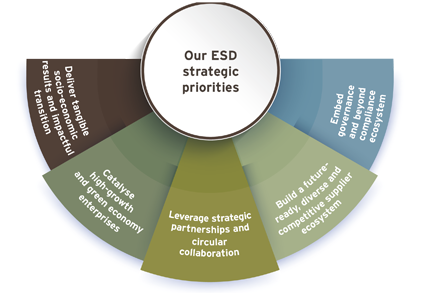
Our ESD approach is guided by our updated strategy, as shown in the graphic alongside. We focus on developing black-owned, black women-owned and black youth-owned enterprises through financial and non-financial support, improved market access and targeted capability building programmes.
Key elements of our approach include:
This enables scalable SMMEs, supports green economy participation and advances transformation while reinforcing supply chain resilience. Strong governance, performance monitoring and ecosystem partnerships ensure that ESD delivers meaningful and sustainable economic outcomes.
In 2025, we evolved our ESD strategy to account for the strategic changes implemented across Exxaro since the original strategy was approved in 2018. The updated approach shifts the programme from a compliance‑driven model to a more integrated, impact‑focused framework. This includes a stronger emphasis on developing high-growth and green economy enterprises, strengthening local economic participation and building a future‑ready supplier ecosystem.
The revised strategy also provides a clearer distinction between national and local beneficiary outcomes, sharper governance mechanisms and an enhanced measurement framework. These changes improve accountability, clarify performance expectations and ensure that ESD is positioned as a strategic lever supporting an impactful transition.
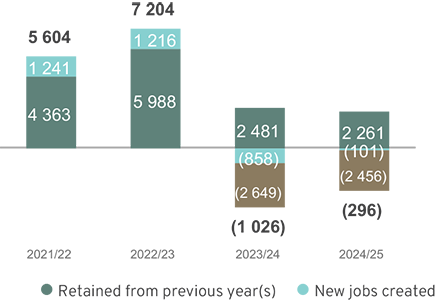
Our ESD programme supports SMMEs with programmes that enable them to grow and create socio-economic impact. Growth is measured through access to new markets, an increase in owned assets and better management of the business. Socio-economic impact is measured through job retention and creation, as well as increase in turnover and contribution to the tax base. By developing enterprises that are competitive and resilient, we help diversify regional economies, reduce dependency on mining and stimulate job creation.
We prioritise supporting enterprises that focus on clean technology, innovation, circular business models and other sectors that align with Exxaro’s broader decarbonisation commitments and transition pathway.
Our partnerships help unlock markets, provide access to technology, enable blended capital solutions and strengthen compliance readiness for SMMEs. They also extend the reach and impact of ESD interventions, particularly in regions where collaboration helps address barriers to market access, supplier readiness and local economic participation.
Exxaro collaborates with a range of stakeholders, including development finance institutions, provincial and national development agencies, original equipment manufacturers, peer corporates and other ecosystem partners. We also participate in ecosystem development forums, where beneficiaries and partners collaborate, share knowledge and develop market access opportunities.
We are creating opportunities for black-owned, black women‑owned and black youth-owned suppliers and supporting them to become long-term participants in Exxaro’s value chain. We do this through:
This approach emphasises diversity, future readiness and competitiveness to strengthen supply chain resilience and align local supplier development with Exxaro’s operational needs.
Our initiatives align with Exxaro’s B-BBEE obligations and are guided by the dtic’s B-BBEE Act and codes, the Department of Small Business Development’s SMMEs and Co-operatives Funding Policy (April 2023) and the Preferential Procurement Policy Framework Act. Exxaro’s ESD programmes not only contribute to our B-BBEE score but also exceed the minimum standards set by local, provincial and national government.
Our funding suite is structured to balance impact, sustainability and compliance. Each mechanism supports enterprises at different stages of maturity and contributes to a financially sustainable ESD programme.
The funding suite supports the shift towards a greater reliance on zero interest loans and co-funding to maintain a self-sustaining programme. This enables us to match financial support to enterprise maturity and risk profile.
| Grants | Recognise 100% of the contributed amount for B-BBEE compliance but require full annual refinancing. They are used primarily for micro‑enterprises selected through structured processes such as the pitch for funding programme, or in exceptional cases where a combined grant and loan solution is appropriate. | |
| Zero interest loans | Provide scalable support for qualifying enterprises assessed through the ESD funding framework. Only 70% of the loan value is recognised for compliance, but the programme is designed to be self-sustaining through repayments. Continued repayments reduce reliance on new budget allocations and support Exxaro’s broader B-BBEE performance. We actively manage the loan book to ensure it remains within acceptable risk levels and contributes to long-term programme sustainability. | |
| Co-funding | By partnering with development finance institutions and other industry collaborators, we expand the reach of the programme and reduce loan book risk. Co-funding does not carry direct compliance recognition but plays a key role in enabling blended capital solutions. | |
| Early payment | Exxaro settles SMME vendor invoices well within the prescribed 15 working days, significantly ahead of standard payment terms, thereby enhancing cash flow and helping these businesses thrive. |
Non-financial support strengthens enterprise capability and enhances long-term competitiveness. Our non-financial offering includes:
The ESD hubs provide multi-year incubation and capacity building programmes tailored to enterprise maturity, including financial management training, compliance readiness support, bookkeeping mentorship and technical guidance. These interventions help enterprises build the technical, financial and operational capabilities they need to operate competitively and sustainably.
| 2025 | 2024 | 2023 | ||
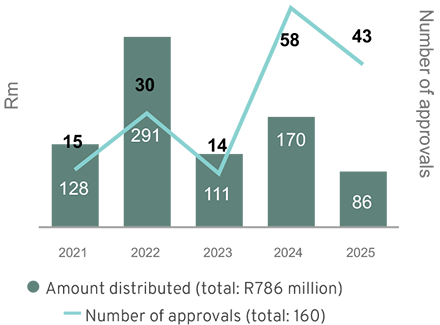
| Approved spend (Rm) | 85.6 | 169.8 | 111.3 | |
| Jobs retained (number) | 979 | 286.0 | 355.0 | |
| Beneficiaries (number) | ||||
| Qualifying small enterprises (QSEs) and exempt micro-enterprises (EMEs) | 43 | 58 | 14 | |
| Youth-owned | 20 | 22 | 1 | |
| Women-owned | 19 | 21 | 9 |

We strengthened the governance and oversight of our ESD loan book to ensure it remains within acceptable risk levels. This included refining screening processes during funding windows, aligning loan decisions with the ESD funding framework and enhancing monitoring of repayment trends. We also implemented enhanced loan recovery measures such as cession and litigation, in line with the National Credit Act.
Demand for financial support continues to exceed available budget, particularly in communities where Exxaro is the only sizeable company and expectations for assistance are high. 2025 (2024: R88.70 million) Outstanding loan book R328.85 million (2024: R84.69 million) This reinforces the importance of maintaining a self-sustaining loan book supported by repayments.
As at the end of December 2025, funding approvals totalled R85.58 million.
Early payment support increased by 40% in 2025, with R0.07 billion disbursed to 549 SMMEs (2024: R0.05 billion to 478). This included 339 EMEs and 210 QSEs, reflecting year-on year increases of 13% and 18% respectively. The programme exceeds B-BBEE requirements by providing critical liquidity for small enterprises.
Our total SMME spend reached R1.87 billion, comprising R0.92 billion to EMEs and R0.95 billion to QSEs.
We expanded several non-financial support programmes to strengthen the capability and competitiveness of SMMEs in our development pipeline.
This new programme was introduced to equip aspiring contractors with the capabilities required to respond successfully to requests for tenders, and improve compliance with relevant legislation.
Rolled out across all BUs, the programme is designed to improve supplier preparedness and strengthen the pipeline of enterprises ready to participate in our value chain.
To broaden our impact, we successfully appointed YIEDI as our implementation partner for the expanded version of this programme, which was rolled out in 2025 with an initial cohort of 18 beneficiaries. The programme provides targeted support to first time contractors through training, gap assessments, business operations improvement and progress monitoring.
In partnership with SAICA, this programme has supported 87 SMMEs over its first three cohorts, creating 102 new jobs, securing new contracts for 16 SMMEs, while 17 expanded their market share and four accessed loan funding to support growth.
The fourth cohort started in 2025, extending support to a new group of entrepreneurs. The programme remains an important lever in improving financial discipline, operational efficiency and long-term sustainability for SMMEs.
In partnership with the Small Enterprise Development and Finance Agency, we provided 29 small enterprises with grant funding of R250 000 each to strengthen their business growth (2024: 27).
We implemented the programme in nine host communities in 2025 (2024: nine).
Now in its second year, the pitch for funding programme supports micro and survivalist SMMEs that are not yet ready for loan financing but show potential for growth with early-stage support.
We expanded the functionality and use of the digitised ESD supplier portal in 2025, which is central to improving transparency, efficiency and accessibility across the programme. The portal enables SMMEs to submit and track applications for financial and non-financial support, while providing access to a structured development pathway.
The platform offers a range of digital tools including:
Increased use of the portal enhanced monitoring, reduced administrative turnaround times and improved the consistency of support delivered across hubs.

2026
key actions
During 2026, we will focus on implementing initiatives that drive the updated strategic objectives outlined in the ESD strategic priorities. These initiatives include:
Maake Mining Services accelerated its growth through a three-year contract at Exxaro’s Grootegeluk mine, supported by targeted ESD funding that strengthened local employment and skills development.
Founded on more than 20 years of industry experience, Maake Mining Services began full operations in 2022 with a focus on safety, quality and community impact. A breakthrough came in August 2024 when the company secured a three-year contract at Grootegeluk to manage cyclic ponds and Dam 5, support loading and hauling activities, and maintain key infrastructure.
To support delivery, the company received R30 million in ESD funding from Exxaro in two tranches during 2024. The funding enabled investment in new machinery, strengthening operational capacity and improving production performance. Structured to align with cash flow, the loan model allowed the business to generate revenue before commencing repayments, supporting financial sustainability.
Since securing the contract, the company has matured operationally, strengthened safety standards and expanded its workforce.