Exxaro Resources Limited
Environmental, social and governance report for the year ended 31 December 2025


Dear shareholders,
It gives me great pleasure to present the remuneration committee report for the year ended 31 December 2025. The committee remains committed to responsible remuneration practices that recognise Exxaro’s people as central to the company’s value creation, while balancing the interests of all stakeholders. Guided by the 2025 slogan, “Exxaro is us – we are Exxaro and together we make it work”, the committee acknowledges the collective contribution and shared accountability of Exxaro’s people, an ethos that informed its oversight of remuneration policies and outcomes.
Dr Phumla Mnganga
Remuneration committee chairperson

The committee benefits from cross-membership with the nomination committee, enabling effective oversight of remuneration matters alongside broader board governance and nomination responsibilities. In accordance with its terms of reference, the committee comprises at least three non-executive directors, the majority of whom are independent, with the board chairperson serving as an ex officio member.
Committee members have a suitably balanced blend of skills and experience to enable the committee to discharge its functions. These members are selected and appointed by the board on recommendation from the nomination committee.
At the AGM in 2025, non-executive director and member of the remuneration committee, Zwelibanzi Mntambo, retired. Billy Mawasha, a standing member of the board and independent non-executive director, was appointed in Zwelibanzi’s place.
The CEO, FD and executive head: people and performance attend meetings as standing invitees to make submissions and provide information required by the committee.
Refer to board of directors for members’ qualifications and experience, and more information in the remuneration report.
Gender and racial diversity
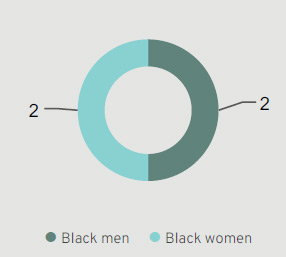
The committee met formally five times during 2025 at four scheduled meetings and one special meeting. The committee’s attendance of 100% indicates high levels of engagement and commitment by its members.
| Members | Designation | Attendance at quarterly meetings | Attendance at special meetings | |||
| Dr Phumla Mnganga | Independent non-executive director and remuneration committee chairperson | 4/4 | 1/1 | |||
| Geraldine Fraser-Moleketi | Lead independent non-executive director | 4/4 | 1/1 | |||
| Zwelibanzi Mntambo* | Independent non-executive director | 1/1 | 1/1 | |||
| Mvuleni Geoffrey Qhena | Non-executive director | 4/4 | 1/1 | |||
| Billy Mawasha** | Independent non-executive director | 2/2 | 0/0 |
| * | Retired on 15 May 2025. |
| ** | Appointed on 5 June 2025. |
This committee’s role and responsibility is to ensure the group remunerates fairly, responsibly and transparently, and that remuneration across the group is aligned to the group’s strategy and governance principles. The committee ensures the continuous development, review and implementation of the remuneration philosophy and policies, and compliance with paragraph 5.7(g) of the JSE Listings Requirements and reporting obligations.
During the year, the remuneration committee oversaw management’s work on key remuneration matters, including wage gap analysis, incentive scheme frameworks reviews and shareholder feedback on remuneration. The committee satisfied itself that these matters were appropriately governed, supported by independent advice where required and aligned with Exxaro’s remuneration policy and regulatory requirements.
The committee’s annual work plan is reviewed as and when required, and amendments must be approved by the board. The annual work plan is amended when there are changes in legislation or regulations to assist the committee in fulfilling its duties in a structured and measured manner.
The committee’s terms of reference are reviewed and approved annually by the board. The November 2025 review ensured alignment with the current status of the business.
King V was implemented on 31 October 2025. Any changes required to align the terms of reference with King V will be presented to the committee in the first quarter of 2026.
While there is no regulatory requirement to conduct annual external independent performance assessments, King IV emphasises the board’s responsibility to regularly evaluate its effectiveness and that of its committees. In support of effective governance outcomes, Exxaro conducts external independent board and committee performance assessments every third year.
The internal evaluation of the committee’s performance and effectiveness was finalised in the first quarter of 2026. The committee scored very high but also realises it faces a pivotal year ahead to ensure that reward practices actively support the company’s transformation into a diversified metals and energy group.
The committee fulfilled its mandate during 2025, and it remains an effectively functioning and contributing arm of the board.
In terms of the JSE Listings Requirements paragraph 5.7(k), if either the remuneration policy or the implementation report or both are voted against by 25% or more of the votes exercised at the AGM, the board must invite dissenting shareholders to engage with Exxaro and provide the manner and timing of such engagement in the voting results announcement.
| Outcomes of two non-binding advisory votes at the AGM on 15 May 2025 | For | Against |
| Non-binding advisory vote number 1: Approval of the Exxaro remuneration policy |
88.78% | 11.22% |
| Non-binding advisory vote number 2: Endorsement of the implementation of the Exxaro remuneration policy |
88.81% | 11.19% |
Although formal shareholder engagement was not required, the chairperson of the committee proactively engaged with shareholders during the 2025 governance roadshow to discuss the outcome of the remuneration policy vote and to better understand the factors contributing to the lower-than-desired level of support. Shareholder feedback informed further roundtable engagements, the outcomes of which will be considered in refining Exxaro’s remuneration structures and practices.
The 2025 governance roadshow, held on 29 and 30 September 2025, was led by the board chair and the chairs of the remuneration, RBR and investment committees. Sessions were conducted with 26 institutions, representing over 80% of Exxaro’s shareholding in Johannesburg and Cape Town.
Discussions highlighted shareholder confidence in Exxaro’s governance and leadership transition. Remuneration remained a key topic, with discussions focusing on the alignment of incentives to Exxaro’s strategy, pay transparency and disclosure readiness under the Companies Amendment Act. Through these engagements, the board reassured shareholders of the progress made on remuneration.
In line with shareholder recommendations, remuneration roundtable discussions were held with major shareholders to test proposed incentive scheme design changes, discuss long‑term incentive plan (LTIP) measures and obtain pre‑AGM alignment. We believe this continuous dialogue will strengthen shareholder trust and reduce the likelihood of dissenting votes.
While the majority of shareholder sentiment is positive, we acknowledge the importance of also addressing the minority concerns. These include greater transparency of peer group composition, stretching performance calibration and simplification of scheme design. This feedback has been incorporated to ensure Exxaro maintains strong shareholder support and continued confidence in its remuneration governance.
Exxaro’s benefits framework continues to evolve to support employee wellbeing and financial resilience.
In line with the group’s ongoing efforts to strengthen employee financial protection and resilience, gap cover and funeral cover were approved by the committee as additional benefits aimed at broadening access to affordable risk protection. Both benefits are fully funded by the employer for all bargaining unit employees, with the funeral cover applicable to all employees except those who are members of the Mineworkers Provident Fund, as the fund already provides this benefit. To further extend financial inclusion, these benefits have been made available to management and specialist employees at preferential, reduced rates, ensuring equitable access to essential coverage across all levels of the organisation.
In addition, medical aid cover was implemented for category A and B employees working in mines-in-closure operations, fully subsidised by the employer, thereby maintaining access to quality healthcare.
Collectively, these initiatives drive Exxaro’s unwavering commitment to employee wellbeing, financial security and inclusivity. They reflect a proactive approach to addressing the wage gap and strengthening the overall employee value proposition.
The two-pot retirement system, operational at Exxaro since 1 September 2024, aims to enhance employees’ access to their retirement savings. The committee requested an update on its implementation and the number of withdrawal claims made by Exxaro employees to the Exxaro-approved retirement funds.
The necessary systems adjustments were made by the relevant funds to enable withdrawals, and member education and communication were conducted through multiple channels, including roadshows. The people and performance business partners were also upskilled to help facilitate claims.
There were no administrative challenges or systems readiness issues, which made implementation smooth, and feedback from BUs has been positive.
Employee financial wellness remains a strategic imperative for Exxaro. An increased focus on short-term withdrawals by employees poses the risk of inadequate retirement benefits. This necessitates enhanced member education, and we will continue to work with the relevant funds to reiterate that the two-pot system is intended for employees to access funds in cases of real emergency.
The recognition policy and programme was comprehensively reviewed to improve governance alignment and embed recognition as a continuous, inclusive practice that reinforces Exxaro’s values and culture. The new recognition standard replaces the former policy and provides a single, group-wide reference for both formal and informal recognition. It clearly defines categories, roles, adjudication levels and responsibilities, simplifying governance while maintaining rigour and transparency.
A comprehensive communication and change management process will support implementation to ensure awareness, understanding and adoption across BUs and functions. This will include leadership briefings, recognition champion training and employee engagement campaigns to embed the standard effectively by 2027.
Our remuneration policy states that non-executive director fees are benchmarked every three years. However, it was agreed that a light-touch benchmark review would be conducted annually between formal benchmarking exercises.
The review confirms that most of Exxaro’s current non-executive director and committee fees remain within the generally accepted market range. However, a few exceptions have emerged, which may require adjustment in the next cycle to maintain alignment with our peers.
The proposed adjustments at this stage are modest, with only a few targeted areas requiring an increase. Given the limited scope of these changes, the financial impact is expected to be manageable and in line with existing remuneration trends and budgets.

2026
focus areas
The committee confirms that remuneration is managed in strict alignment with Exxaro’s remuneration principles, policy and supporting guidelines, ensuring robust governance and fair, responsible pay outcomes. The committee is confident that all commitments set for 2025 have either been fully delivered or are progressing as planned.
Dr Phumla Mnganga
Remuneration committee chairperson
29 April 2026