Exxaro Resources Limited
Environmental, social and governance report for the year ended 31 December 2025


Mining environments expose employees to occupational health risks such as dust, noise and fatigue, while broader social and economic pressures influence mental wellbeing. Stakeholders expect Exxaro to provide safe, healthy and supportive workplaces.
Effective health and wellness management enhances workforce productivity and resilience, advancing our strategic objective of empowering people to create impact.
SERC and RBR committee
Oversees health and wellness risks and performance, ensuring alignment with legal obligations and group-wide sustainability commitments
The executive head: sustainability monitors the implementation of our health and safety policy, delegating authority to BUs and sustainability managers to ensure consistent application of standards across operations
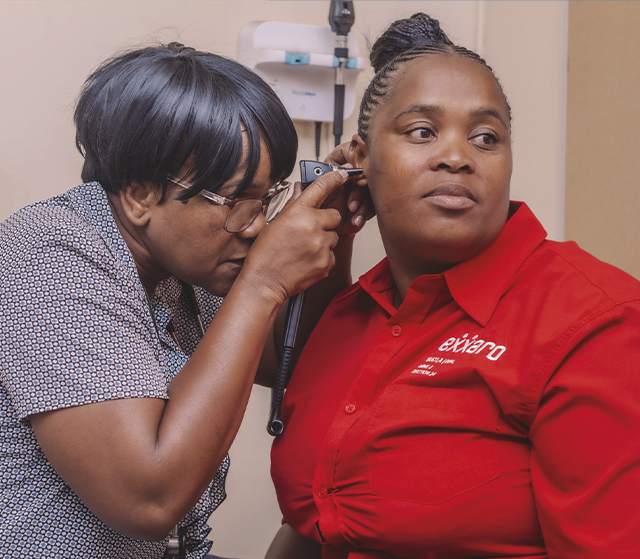
On-site health practitioners implement health and wellness programmes, conduct medical surveillance and wellness campaigns, ensure compliance with regulatory requirements and track site-specific performance and emerging risks
We follow a preventive, employee-centred approach to health and wellness. Guided by our integrated health and wellness strategy, we identify and address occupational, non‑occupational and mental health risks to reduce their causes and impacts on our people and business. Our approach combines medical screening and surveillance, wellness promotion and psychosocial support, delivered through on-site health services, awareness campaigns, testing drives and targeted behavioural interventions.
Key elements of our approach include:
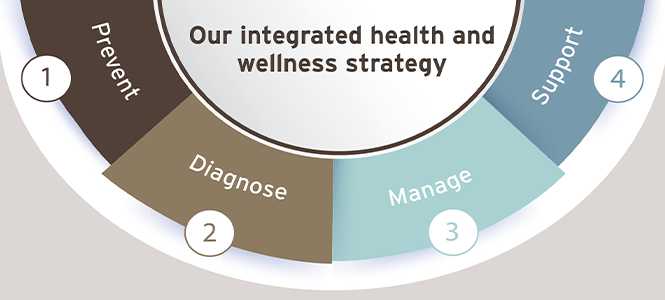
Prevent
Prioritising early intervention by running awareness campaigns, on-site screening days, health testing drives and wellness initiatives. These programmes help identify risks early and encourage healthier lifestyle choices across the workforce.
Diagnose
Strengthening medical surveillance by expanding BU-level clinical testing for chronic conditions, heart disease and cancer risk. This includes specialised diagnostics, such as DNA-based screening, for employees from middle management upward.
Manage
Improving long-term health management by ensuring all employees with occupational and non-occupational health risks are enrolled in disease management programmes and receive ongoing monitoring, treatment guidance and follow-up care.
Support
Enhancing employee wellbeing through psychosocial and practical support services, including counselling and trauma debriefing, onsite therapists, virtual mental health masterclasses, internal awareness campaigns and access to financial counselling.
We provide access to external counselling services and targeted interventions to support employees across the group. We have also reviewed our wellness strategy to ensure that it comprehensively addresses all key areas required within the framework and effectively responds to the diverse needs of our employees.
The revised strategy takes into account emerging workplace challenges, aligns with organisational values and strengthens our commitment to supporting employees’ physical, psychological and financial wellbeing.
We create awareness through LetsConnect, screensavers, LCD displays, the intranet and SMS updates that share EWP contact details. We include EWP access in induction processes and fit‑for‑work assessments to ensure employees understand how to seek assistance.
Mental health remains an important part of the EWP. We offer mental health masterclasses and sessions at BUs to equip our employees with self-diagnosis techniques and practical coping strategies. On-site therapists are available at all BUs.
Bayport Financial Services complements this offering with debt counselling, restructuring, financial rehabilitation and financial management training for employees facing hardship.
We apply proactive measures to promote healthy lifestyles and reduce the risk of preventable illnesses. We use real-time monitoring devices during wellness campaigns to assess blood pressure, blood sugar, fatigue and stress levels, giving employees immediate insight into their health status. Dieticians provide personalised guidance based on these results, helping employees understand their risks early and make informed changes that support long-term wellbeing.
Our wellness coordinators engage regularly with BU teams to identify emerging issues and ensure interventions are timely and targeted.
Monitoring occupational and non-occupational (lifestyle) diseases helps us track trends, identify emerging health risks and guide preventive action. Our surveillance covers communicable illnesses, such as occupational TB, and non-communicable conditions linked to dust, noise and lifestyle factors.
| Occupational diseases | TB and hepatitis B contracted at work | |
| Non-occupational diseases | Cholera, malaria, typhoid, influenza and sexually transmitted infections |
| Occupational diseases | Noise-induced hearing loss (NIHL), pneumoconiosis, silicosis, chronic obstructive airway disease and occupational asthma | |
| Non-occupational diseases | Diabetes, hypertension and cardiovascular ailments |
We work with a broad network of stakeholders to strengthen occupational and public health outcomes, extend screening capacity and align our practices with industry and national priorities.
Our key collaborations include:
| Employees | Partnering with employees through awareness, screening and wellness initiatives that support the prevention, diagnosis and management of occupational and non-occupational health risks | |
| Mine Health and Safety Council | Engaging across all BUs to assess progress against the new occupational health milestones announced in 2024, ensuring alignment with industry standards and continuous improvement in health and hygiene performance | |
| Minerals Council South Africa | Sharing information, participating in occupational health forums and contributing to industry initiatives focused on noise reduction, dust management and occupational hygiene. Performance is tracked through the council’s health and hygiene dashboard | |
| National and provincial Department of Health (DoH) | Collaborating to strengthen public health programmes, including TB and HIV screening, awareness campaigns, access to chronic medication and improving continuity of care for employees |
EWP |
||||
| 2025 | 2024 | 2023 | ||
| Utilisation rate (%) | 7.5 | 7.8 | 8.9 | |
| Proactive Health Solutions benchmark (%) | 6 | 5.3 | 6.4 | |
| Cases managed | 3 678 | 3 785 | 6 350 | |
| Individual cases | 525 | 541 | 716 | |
| Individuals in group trauma debriefing sessions | 842 | 615 | 578 | |
| Individuals in group information sessions | 2 311 | 3 781 | 5 056 |
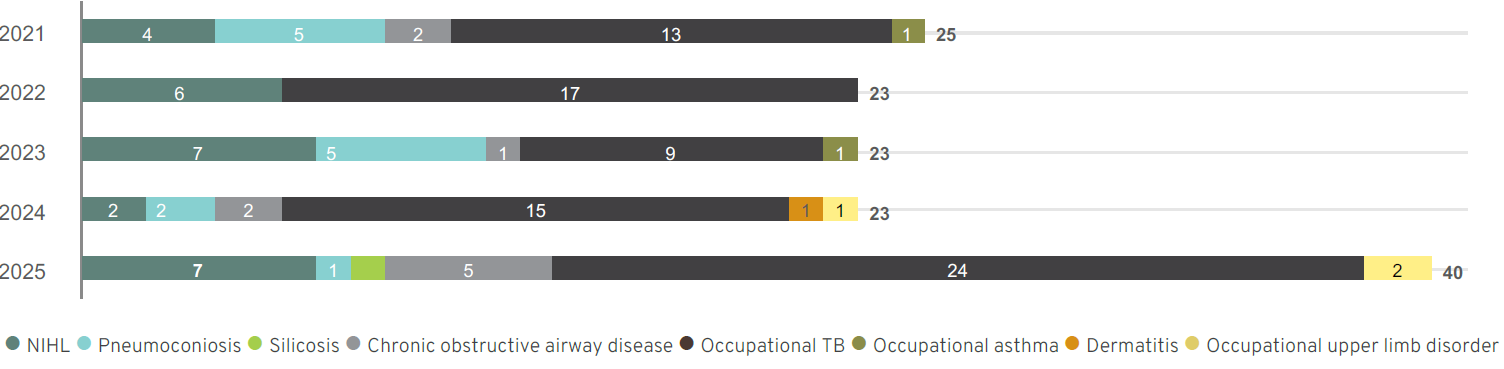
In 2025, we recorded 40 occupational disease cases (2024: 23), resulting in an OHIFR of 0.22 (2024: 0.14) against the target of 0.13.
Reported number of cases
Risk mitigation measures
Our hearing conservation programme helps limit NIHL through engineering controls, improved monitoring and targeted awareness.
BUs implement the following risk mitigation measures:
We conduct regular checks and tests to ensure hearing protection and controls remain effective, and reinforce awareness of workplace noise risks and protective measures through induction sessions across all BUs.
Risk mitigation measures
BUs maintain exposure levels below the industry milestone and ensuring controls remain effective through routine assessments and occupational hygiene surveillance.
We have not recorded silicosis cases since 2019. Dust control remains a priority across operations, with continued improvement in dust suppression, housekeeping and real-time particulate monitoring.
Risk mitigation measures
Exxaro maintains a low incidence of pneumoconiosis due to targeted interventions when over-exposures are identified. BUs implement corrective measures that include:
These actions support alignment with the MHSC milestones and maintain performance below industry thresholds.
We identified 30 new diabetes cases (2024: 39) and 148 hypertensive employees and contractors (2024: 122).
We report against the industry TB and HIV targets on the Minerals Council’s Masoyise dashboard.
| HIV/Aids awareness (employees and contractors) |
2025 | 2024 | 2023 | |
| Attended counselling sessions | 13 257 | 14 143 | 18 419 | |
| Total tested (voluntary) | 13 008 | 13 459 | 12 597 | |
| % tested | 98 | 94.33 | 68.39 | |
| Employees tested positive | 82 | 189 | 236 | |
| Enrolled as at December 2025 (cumulative) | 1 576 | 1 548 | 2 123 | |
| Received antiretroviral treatment | 1 576 | 1 548 | 4 815 |
We integrate HIV/Aids awareness into our medical inductions, with dedicated campaigns encouraging voluntary counselling and testing. Healthcare centres provide employees with medication that supports early treatment and better health outcomes.

2026
key actions
In 2025, all BUs formally adopted Exxaro’s updated wellness programme, which was integrated into daily operations to strengthen health, wellbeing and productivity. BU engagements with wellness coordinators informed the roll-out, ensuring that the programme reflects site-specific needs and supports consistent group-wide implementation.
We also advanced our health agenda under the prevent, diagnose and manage framework through key wellness initiatives, including TB and flu campaigns, mental health and cancer masterclasses, cancer screenings, World Aids Day activities, wellness and sports events, the peer educator and fatigue management programmes, and mobile community health outreach.
Demand for psychological support increased during the year, prompting several BUs, including Grootegeluk, to extend the operating hours of on-site therapists. The additional capacity improved access to counselling, boosted participation and strengthened referral pathways for employees requiring continued care.
All BUs use continuous real-time health and hygiene monitoring systems integrated with the SCADA platform, enabling more accurate tracking of occupational health risks and data-driven decision making. Belfast began the first phase of wearable health device distribution, with a dietician providing personalised guidance based on real-time health indicators.
We strengthened our proactive health management approach by supporting our host communities through targeted partnerships and outreach initiatives. Working with the SANAC Private Sector Forum, we continued our community health screening programme in Limpopo and Mpumalanga. The co-funded initiative reached 11 136 community members in 2025 and is set to expand to mine closure communities in 2026.
Under our MoU with the Limpopo and Mpumalanga DoH, we also advanced several public health initiatives. These included medical circumcision campaigns, donations of HIV-related materials, rural health outreach efforts, community mammogram services and awareness campaigns on GBV, breast cancer and mental health. Additional activities included oral health campaigns, participation in the Waterberg executive mayor’s integrated health screening initiative and ongoing “taking service to the community” programmes.
Rising lifestyle health risks and the need for stronger mental health support highlighted the importance of preventive healthcare across our operations. Throughout the year, we organised wellness events and awareness programmes to promote early detection, build health literacy and strengthen employee and community wellbeing. We combined education, targeted screenings and accessible support services to reinforce our commitment to creating a healthier and more resilient workforce.
Exxaro Race for Health
More than 7 000 runners participated, promoting physical fitness and strengthening community involvement.
Cancer awareness campaigns
All BUs ran October campaigns aligned with the wellness calendar, reinforcing early detection and proactive health management.
Health awareness masterclasses
Sessions focused on mental health and cancer, encouraging informed decision making and a culture of openness.
Financial wellness outreach
Social media campaigns expanded access to financial literacy tools for employees and community members.
Preventive health interventions
In partnership with the DoH, 1 009 male medical circumcisions were facilitated as part of broader public health efforts.
Wellness days across operations
Screening for lifestyle diseases, with guidance on nutrition, physical activity and early risk identification.