
Exxaro Resources Limited
Environmental, social and governance report for the year ended 31 December 2025


On behalf of the board, I am pleased to present Exxaro’s 2025 remuneration report.
Dr Phumla Mnganga
Remuneration committee chairperson

Remuneration outcomes for 2025 reflect a balanced view of performance. While certain financial metrics were impacted by market conditions, the group delivered important strategic, operational and leadership outcomes. The remuneration committee carefully considered this context to ensure that incentive outcomes remained fair, aligned to performance and consistent with the principle of responsible remuneration.
Team Exxaro ensured that the business remained stable during a period of uncertainty, supported by a seamless leadership transition and the continued strengthening of our leadership bench.
We further aligned our organisational structure to our strategy, enabling clearer accountability and more effective execution, while driving a culture and ethics reset across the group. Operationally, we attained exceptional safety performance and significantly increased the pace and intensity of execution of strategic priorities.
In order to ensure fair and responsible remuneration outcomes for the year, the committee considered the extent to which leadership effort, the pace of execution and organisational delivery were fully reflected in the original performance scorecards. In line with the approved remuneration policy, the committee marginally moderated the scorecard outcomes for the GIS and the Cennergi STI scheme. These measured refinements ensured that outcomes remained appropriately aligned to overall performance, while supporting the long-term interests of shareholders.
Exxaro’s portfolio now spans coal operations, renewable energy through Cennergi and an expanding pipeline of transition metals. During the year, the group progressed its diversification strategy through the acquisition of select manganese assets, strengthening Exxaro’s exposure to metals that support the global energy transition.
As Exxaro evolves into a more diversified mining and energy business, the remuneration committee continues to ensure that the remuneration framework remains aligned with the evolving economic drivers of the portfolio and supports the sustainable creation of long-term shareholder value.
This remuneration report is presented against this evolving operating environment and is intended to explain clearly how Exxaro’s remuneration framework continues to support the group’s strategy, performance and long-term sustainability.
The remuneration report is structured in three sections. The remuneration policy (section 2) sets out Exxaro’s forward‑looking approach to reward, including the principles, governance and frameworks that guide how remuneration is determined across the group. The implementation report (section 3) explains how this policy was applied during the 2025 financial year, including the outcomes of incentive schemes, fixed and variable pay decisions and payments made to executive directors, prescribed officers and non-executive directors.
Together, these sections are designed to provide shareholders with a transparent and comprehensive view of how remuneration outcomes for 2025 reflect both financial performance as well as the broader strategic and operational delivery of the group. This includes how the committee applied judgement to ensure that outcomes remained fair, balanced and aligned with long-term value creation.
The report also reflects the increasing importance of strong governance, fairness and sustainability considerations in remuneration design, as Exxaro continues its transition toward a more diversified and future-focused business.
A central pillar of Exxaro’s remuneration philosophy is the alignment between executive reward and the long-term interests of shareholders. The group’s incentive structures are designed to ensure that a significant portion of executive remuneration is variable (ie at risk), performance-based and linked to the creation of sustainable value over time. Through a combination of STIs and LTIs, share-based awards and MSRs, executive leadership is directly exposed to the same value drivers as shareholders, reinforcing a strong alignment between strategic decision making, capital discipline and shareholder returns.
Please see our remuneration committee report.
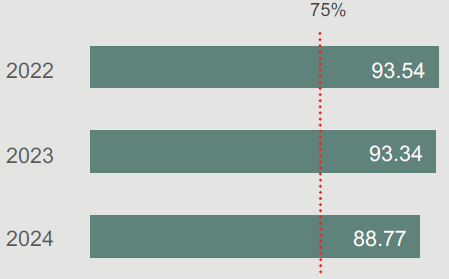
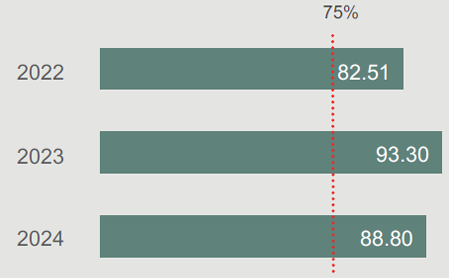
Over the past three years, our shareholders have consistently demonstrated strong support for Exxaro’s remuneration policy and its implementation. These voting outcomes provide an important governance indicator of confidence in the group’s remuneration framework, while also reinforcing the importance of continued engagement and refinement as Exxaro’s strategy and portfolio evolve.
Exxaro continues to receive strong shareholder support for its remuneration policy and the implementation of remuneration outcomes as well as the non-executive fees.
Remuneration policy (%)
Implementation report (%)
Non-executive director fees (%)
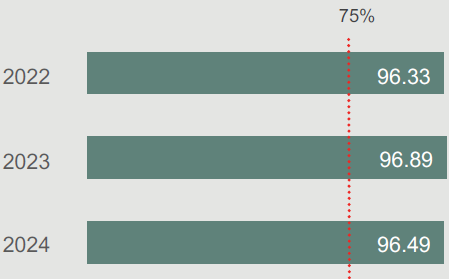
These voting outcomes demonstrate consistent shareholder support for the overall remuneration framework while reinforcing the importance of continued engagement and transparency.
Remuneration is always a key focus during Exxaro’s annual board governance roadshow. During 2025, however, it became clear that the time available in the traditional roadshow format was insufficient to engage meaningfully on the increasingly complex and technical aspects of remuneration incentive design, particularly in the context of Exxaro’s strategic diversification and the energy transition.
In response, we introduced a series of dedicated remuneration roundtables in November 2025. This approach was experimental for Exxaro but proved highly effective. Shareholders representing a sizeable portion of the group’s issued share capital, participated. The roundtable format allowed for deeper, more candid and more constructive engagement on topics such as incentive design, ESG measures, wage gap governance and long-term value alignment than is possible in a standard roadshow setting.
Across both the roadshow and the roundtables, shareholders expressed strong support for Exxaro’s remuneration philosophy and its emphasis on pay at risk, long-term strategic alignment and governance discipline. At the same time, they encouraged the company to continue refining incentive design to ensure that outcomes reflect what management can control and how the group’s portfolio is evolving.
The key themes raised by shareholders included the sensitivity of incentives to commodity prices, the credibility of ESG measures, the alignment of ROCE and TSR to a diversified business, the modernisation of legacy incentive structures, the integration of Cennergi schemes and the robustness of wage gap governance.
The feedback received through both the roadshow and the roundtables directly informed the refinements being made to our remuneration framework. These include adjustments to incentive performance measures, the removal of the legacy matching share scheme and the introduction of the DBS scheme, and enhancements to governance mechanisms. This iterative approach ensures that the remuneration framework continues to evolve in line with shareholder expectations and the group’s strategic direction.
Shareholder concern |
Our response |
| STI outcomes are overly sensitive to coal prices and EBITDA volatility | We acknowledged that EBITDA, particularly when driven by coal price movements, can introduce volatility into STI outcomes that is not always aligned to management’s controllable performance. We have thoroughly reviewed the STI scorecard to rebalance the weighting between cost management and operational delivery, while retaining an appropriate link to overall financial performance. |
| The FTSE Russell Index lacks credibility as an ESG long‑term incentive performance measure | We recognised that the FTSE Russell Index does not adequately reflect Exxaro’s sustainability priorities or its transition to a diversified mining and energy business. For 2025, as an interim measure, the weighting of this measure was reduced, with ROCE and TSR increased. In parallel, we have now developed bespoke ESG measures linked to decarbonisation, rehabilitation and low-carbon transition objectives, which replaces the FTSE Russell measure from 2026. |
| ROCE and TSR do not fully reflect Exxaro’s diversified portfolio | Following shareholder feedback, the committee undertook a comprehensive review of the LTIP performance measures. We believe ROCE remains an appropriate measure for a capital-intensive business. The TSR measure has also been enhanced through the introduction of a broader coal peer group and revised peer group weightings to better reflect Exxaro’s business mix and shareholder return drivers. |
| The DBP is outdated and misaligned with best practice | The board approved the introduction of a DBS structure to replace the DBP. The DBS framework simplifies participation and aligns deferred equity with the performance outcomes of the GIS. |
| The ESOP does not provide meaningful ownership or engagement | We confirmed that the ESOP is being reviewed to improve capital participation, affordability and alignment with B-BBEE and employee engagement objectives. Alternative structures will be considered in 2026. |
| Cennergi’s STI and LTI schemes appear misaligned with the group framework | While recognising the unique characteristics of the energy business, we will strive to ensure that Cennergi’s VARP and BMP are fully aligned to Exxaro’s remuneration philosophy and governance standards as part of the group-wide incentive redesign currently underway. This will be prioritised in 2026. |
| Wage gap governance and living wage credibility require stronger transparency | The committee continues to strengthen the group’s governance and analytical framework relating to fair and responsible pay. We confirmed that independent analytics are being undertaken, that the 5:5 ratio has been adopted and hope that participation in the Living Wage South Africa Network will provide a credible external benchmark. These measures are supported by enhanced benefits for lower-paid employees. |
Shareholders also engaged the board on the governance of nonexecutive director fees, including the appropriateness of Exxaro’s comparator group and the positioning of fees across the board and its committees. We once again tested our peer group and believe that that they are still appropriate.

Investors were particularly focused on ensuring that non-executive director remuneration remains aligned to market practice, reflects the increasing complexity of the group and is managed within a disciplined and transparent framework. Exxaro confirmed that nonexecutive director fees are benchmarked against a carefully selected peer group that reflects the group’s size, complexity and market capitalisation, and that fees are managed within a strict tolerance range of 80% to 120% of the market median. A light‑touch update of the 2024 benchmarking exercise was undertaken during 2025 to ensure that Exxaro’s fee positioning remains appropriate as market levels evolve.
This review confirmed that most board and committee member fees remained within the desired market range, while specific committee chairperson and member fees are being normalised over time where historical misalignment existed. Targeted corrective increases are applied where market movement required adjustment, particularly for the audit committee and the nominations committee, while fees for certain committees were deliberately held flat to bring them back within tolerance. Importantly, these adjustments were structured so that the overall cost of the board does not increase for 2026, reinforcing Exxaro’s commitment to responsible and disciplined governance of director remuneration.
A number of key employment-related changes affecting the group’s executive directors and prescribed officers occurred during the reporting period. These included new appointments, contract terms, resignations, retirements and any suspensions or terminations. These movements are considered within the broader context of the group’s governance and succession planning framework, ensuring continuity, stability and alignment with our long-term strategic objectives.
The group’s approach to termination benefits is governed by contractual agreements, regulatory requirements and incentive scheme rules. This ensures fair and responsible treatment of executives while safeguarding shareholder interests. Termination benefits, where applicable, are aligned with market practices and company policy.
The following changes in executive leadership were made:
The treatment of variable pay upon termination depends on the nature of the departure:
Exxaro remains firmly committed to fair and responsible pay across the organisation. During 2025, the group continued to advance its wage gap journey through enhanced analytics, benchmarking and governance, supported by independent advisers. This included assessing both vertical and horizontal pay gaps, continuing to measure our 5:5 ratio and progressing the establishment of an Exxaro living wage reference.
In parallel, Exxaro strengthened the total reward offering for lowerpaid employees through the introduction of employer-funded medical aid, gap cover and funeral benefits, reinforcing financial security and dignity at work while supporting a more equitable and sustainable remuneration framework across the group.
While the group is well advanced in its wage gap analysis and disclosure readiness, formal disclosure will be implemented in line with regulatory requirements once the applicable provisions are enacted.
The Companies Amendment Act introduces mandatory disclosure of wage gap metrics; however, the effective date of these provisions and the final definition of an “employee” for this purpose have not yet been promulgated. In particular, the inclusion or exclusion of learners, interns and trainees remains under consideration by government, and this classification has a material impact on vertical wage gap outcomes in a large, skills pipeline organisation such as Exxaro.
During 2025, the remuneration committee discussed this matter with shareholders and explained that the inclusion of these categories would significantly distort vertical wage gap ratios, given their developmental nature and stipend-based remuneration. In the interim, Exxaro will therefore continue not to disclose its wage gap ratios but will do so in line with legislative requirements, supported by the independent analytics and governance structures already in place. These regulatory developments and the evolving expectations around fair and responsible pay made meaningful and transparent engagement with shareholders particularly important during 2025.
In line with South African governance requirements, shareholders vote separately on the forward-looking remuneration policy and on the implementation of remuneration outcomes for the year under review. Where the remuneration policy or implementation report receives significant shareholder dissent, companies are expected to engage with shareholders, explain how their concerns have been addressed and disclose the outcomes of that engagement. These provisions reinforce the importance of transparent reporting, robust incentive design and meaningful shareholder engagement in the governance of executive remuneration.
Against this backdrop, we have deliberately strengthened both the substance and quality of our remuneration disclosures and shareholder engagement practices. We recognise that remuneration governance carries not only reputational implications but also increasing regulatory and board-level accountability. Our approach is therefore to ensure that remuneration outcomes remain clearly aligned with performance, strategy execution and the long-term interests of our shareholders.
In this context, our remuneration governance framework continues to be guided by the principles of the King IV Report on Corporate Governance for South Africa.
The governance of non-executive director remuneration is guided by the principles of King IV, which emphasise independence, fairness, transparency and the alignment of reward with the long‑term interests of the company and its stakeholders. In line with these principles, Exxaro’s approach to non-executive director fees is based on independent market benchmarking, disciplined fee positioning and clear shareholder oversight.
In addition, the Companies Act requires that non-executive director fees be approved by shareholders through a special resolution at least every two years. The fees proposed by the board for 2026, informed by the independent benchmarking process and the tolerance framework applied by the remuneration committee, will therefore be tabled for shareholder approval at the 2026 AGM. This ensures that shareholders retain a direct and binding say over the level and structure of non-executive director remuneration, reinforcing accountability and confidence in the governance of the board.
In 2026, the remuneration committee will focus on embedding the next phase of Exxaro’s remuneration framework to support the group’s evolving strategy and long‑term value creation.

Looking
ahead
Exxaro continues to seek independent and professional advice on remuneration matters from consultants regarded by the committee as fully independent. During 2025, advisers included Vasdex Associates, Remchannel, Bowmans, 21st Century, Deloitte and Kornferry.
On behalf of the remuneration committee, I would like to thank the executive committee and the group reward team for the extensive technical work, analysis and governance discipline applied during the year. I also thank my fellow remuneration committee members for their rigorous oversight, challenge and contribution to the evolution of Exxaro’s remuneration framework during a period of significant strategic change. Finally, I thank our shareholders for their constructive engagement, which has been instrumental in shaping a remuneration approach that is fair, responsible and aligned with long-term value creation.
Dr Phumla Mnganga
Remuneration committee chairperson
29 April 2026