
Exxaro Resources Limited
Environmental, social and governance report for the year ended 31 December 2025


We strive to attract, inspire and retain the best talent to achieve our Sustainable Growth and Impact strategy and create sustainable stakeholder value.
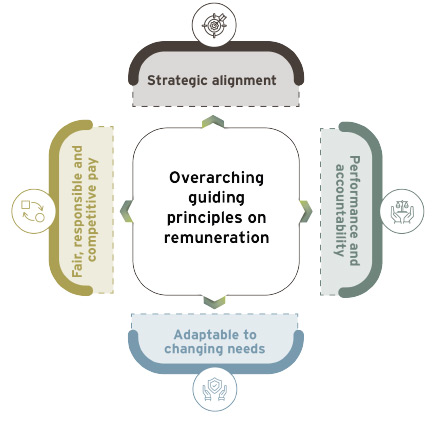
| Element | Purpose | Who benefits | How it is applied | |||
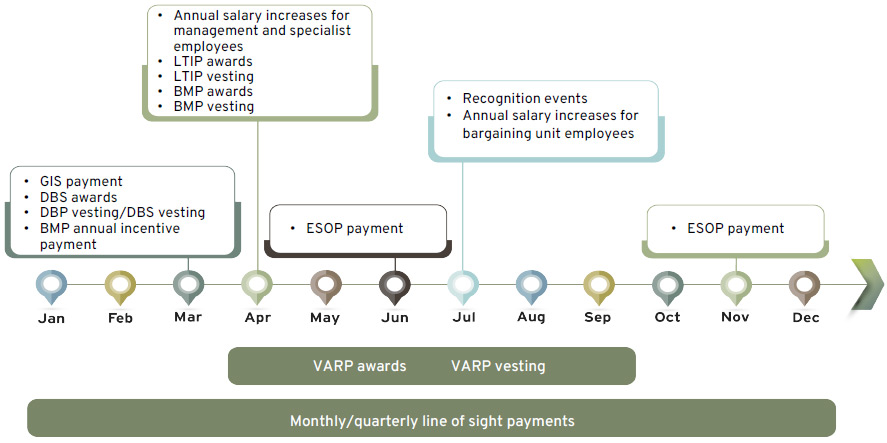
| Guaranteed pay | Ensures market competitiveness and fairness while facilitating the attraction and retention of talent | All employees | Benchmarked against peers using a lead-lag approach. Our guaranteed pay lags the market at executive director and prescribed officer levels | |||
| Benefits | Provides for future security, protection and wellness | All employees | Includes retirement planning, risk benefits, medical aid and wellness programmes, etc | |||
| STI | Supports annual performance objectives delivery and retention of talent | All employees | Based on business (operational, financial and ESG) targets and individual performance | |||
| LTI | Supports the longer-term delivery of the group’s key strategic objectives and ensures the alignment of management and shareholder interests as well as the retention of talent | Middle management and above employees | Exxaro LTI Based on business performance (financial and ESG) over a three-year period Cennergi LTI Based on business performance conditions |
|||
| ESOP | Fosters a sense of participation in the company’s success by aligning employee and shareholder interests | Junior management and below employees | Paid twice a year as an amount equivalent to the dividend paid on 560 Exxaro shares | |||
| Recognition | Celebrates exceptional contributions, fosters a culture of appreciation and honours loyalty | All employees | Formal recognition events and longservice awards | |||
During 2025, we made a number of refinements to our remuneration policy. From 1 January 2026, these changes are intended to further strengthen the alignment between executive remuneration, long-term value creation and shareholder interests.
| Element | Purpose | |
| Introduction of the deferred bonus scheme (DBS) |
The DBS structure simplifies the previous matching share arrangement by removing the requirement for employee co-investment and introducing a deferral mechanism that is directly linked to the outcome of the GIS. | |
| Refinement of the LTIP performance measures |
The ESG performance measure, FTSE Russell Index, was replaced with operationally measurable sustainability targets, including decarbonisation and rehabilitation performance measures. In addition, refinements were made to the total shareholder return (TSR) peer group and return on capital employed (ROCE) performance measures. | |
| Strengthening of malus and clawback provisions |
The malus and clawback policy was updated to strengthen governance oversight of incentive outcomes and extends the scope of the policy to a broader group of participants across the company’s variable remuneration schemes. | |
| Application of MSR to the CEO | The remuneration committee exercised its discretion under the MSR policy to align the CEO’s MSR with the CEO’s three-year fixed-term contract. The requirement will therefore apply on a proportionate basis during the contractual period. This arrangement is intended as an interim measure pending the broader MSR policy review planned for 2026. | |
| Enhancement of annual leave benefits |
As part of Exxaro’s employee value proposition, annual leave for management and specialist employees will increase from 15 to 17 working days with effect from 2026. The enhancement has been incorporated within the overall remuneration framework and funded as part of the annual remuneration allocation process. | |
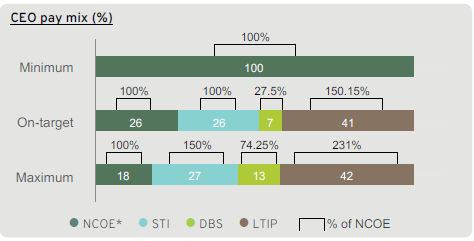
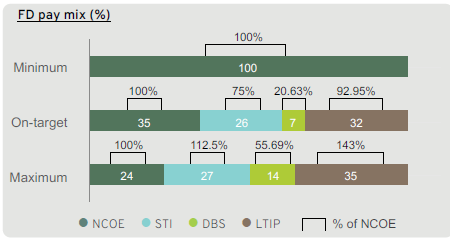
* Notional cost of employment.
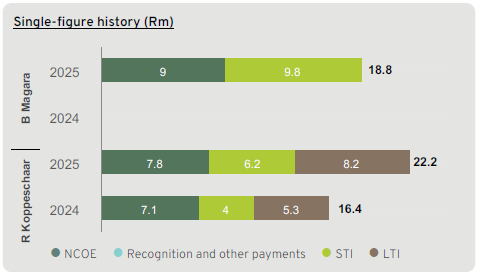
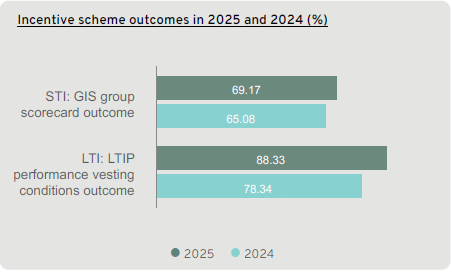
In terms of the STI: GIS outcome, our 2025 financial performance improved in terms of the cash cost per tonne and saleable tonnes targets compared to 2024. However, performance declined in terms of the group EBITDA* targets compared to 2024.The reason for this was the unbudgeted costs incurred in order to accelerate the execution of the strategy.
In terms of the LTI: LTIP, we achieved 100% of the vesting targets on the ROCE and ESG performance conditions compared to 2024, and a higher vesting on the TSR performance condition compared to 2024.
| * | Net operating profit before interest, tax, depreciation, amortisation, impairment charges or reversals, net losses, or gains on the disposal of assets and investments (including translation differences recycled to profit or loss) and corporate service fees |