Exxaro Resources Limited
Environmental, social and governance report for the year ended 31 December 2025


In line with King IV’s recommendation to apply and explain good governance practices, Exxaro’s corporate governance reporting is structured under the four desired King IV governance outcomes.
We demonstrate our alignment with King IV principles and the regulatory requirements that ensure ethical leadership, accountability and transparency.
Good governance underpins our ethical culture, safeguards human rights and supports our sustainable growth while we transition to a low-carbon world.
We aspire to promote a workplace culture that prioritises ethical behaviour across Exxaro and empowers our people to apply an ethical lens in daily decision making and actions.
In 2025, Exxaro reviewed the ethics strategy and implementation plan to evaluate continued relevance and effectiveness. The review aimed to confirm that the ethics strategy remains fit for purpose in supporting Exxaro’s goal of becoming a diversified natural resources champion while fostering a sustainable, resilient and trusted organisational culture. A new strategy was subsequently adopted.
The new strategy reinforces Exxaro’s commitment to embedding ethical conduct as a core organisational value. It reflects a culture where ethical considerations guide daily decision making and where employees are empowered and accountable to act with integrity at all levels of the business.
This renewed focus recognises that diversification, growth and increased organisational complexity require a strong, values‑driven culture underpinned by ethical decision making.
The board sets the ethical tone for Exxaro, ensuring that the company operates as a responsible corporate citizen. Through its commitment to ethical and effective leadership, the board fosters a strong ethical culture and positions ethical conduct as the foundation for the group’s operations and stakeholder value creation. This commitment is embedded through the group’s code of ethics, supporting policies and comprehensive culture programmes.
Exxaro’s code of ethics promotes values such as trust, integrity and fairness, guiding our interactions within the company and with stakeholders. As a responsible corporate citizen, the board acts decisively when ethical principles are breached by ensuring that appropriate sanctions and remedial actions are applied consistently while providing clear, strategic direction to management to support long-term sustainable value for shareholders and society.
Ethical conduct is a shared responsibility. Employees are accountable for safeguarding trust and confidence and for doing the right thing, whether required by law or policy or when no one is watching. Sound judgement, integrity and the courage to act in accordance with our values are non-negotiable.
Our management ethics committee ensures that high ethical standards are maintained in Exxaro’s business conduct. It is responsible for evaluating all instances of alleged misconduct, including fraud, extortion, bribery, corruption, potential conflicts of interest, violations of the code of ethics and related ethics matters. The committee also oversees anti‑fraud and anti-bribery initiatives as part of a comprehensive fraud prevention programme, ensuring compliance with both local and international laws and regulations.
To support Exxaro’s vision of becoming a diversified natural resources champion that creates value for all stakeholders through exceptional people and superior processes, Exxaro’s business conduct and that of our employees must be characterised by the following fundamental values:
Exxaro applies the OECD recommendations on ethical behaviour through a risk-based due diligence framework covering suppliers, customers, employees and business partners. This framework supports the identification, prevention and mitigation of ethical, legal and human rights risks and reinforces responsible business conduct across the group’s operations and value chain.
A successful ethics management framework comprises four key elements: ethical leadership; governance structures that set the strategy and policies guiding the organisation’s ethical performance; personnel and structures responsible for managing and implementing the organisation’s ethics initiatives; and independent assurance, such as internal audit evaluations.
At Exxaro, the board monitors the group’s ethical culture through reporting structures, including two board committees (SERC and audit), a management ethics committee, the internal audit function, head of internal audit and our newly appointed chief ethics officer.
Guided by the ethics management strategy, the chief ethics officer is responsible for ensuring that there are appropriate systems, processes and controls to support and sustain integrity across the group. An ethics implementation framework outlines 18 interventions to address three focal areas: ethical culture; governance structures and frameworks; and ethics-related risk mitigation.
These efforts reinforce “The Exxaro Way” – a living set of shared values, beliefs and practices that guide how we do things.
Exxaro’s first intervention in fostering an ethical culture is a targeted ethics training plan that provides tailored awareness and capacity building for employees at all levels. This includes an ethics onboarding module for new joiners, everyday ethics training for all employees and guidance for leaders to demonstrate ethical intent in their decisions and show empathy in their conduct to build legitimacy with stakeholders.
“Mining with morals” training continued in 2025, deepening employees’ understanding of ethical decision making and reinforcing a strong speak-up culture across the organisation using interactive case studies. Conflicts of interest awareness also featured prominently on the 2025 agenda, with mandatory training conducted across all sites. This was supported by a digital conflict of interest register and management system, along with a comprehensive review of the conflict of interest policy to ensure alignment with the applicable legal, regulatory and ethical governance standards. Similarly, management and logging of gifts and benefits continued to promote transparency and prevent potential conflicts.
Ethics awareness extends beyond our organisation to our valued stakeholders. On 30 September 2025, Exxaro hosted the inaugural Supplier Ethixx Day under the theme “Ethical partnerships for lasting impact” to engage suppliers on ethical conduct. We believe this is a milestone in our shared journey towards ethical relationships, responsible sourcing and sustainable partnerships.
The Supplier Ethixx Day provided a platform for collaboration, reflection and commitment to the values that define Exxaro’s supply chain. At the end of the event, management and suppliers signed a pledge to work ‘The Exxaro Way,’ reinforcing a shared commitment to building a supply chain founded on ethical conduct.
We encourage employees and stakeholders to report suspected fraud, corruption or human rights violations through our fraud and ethics hotline. The hotline is independently managed, with clear escalation protocols in place.
To maintain the hotline’s integrity, we protect the interests of disclosing parties as far as possible.
Free call: 0800 203 3579
Email: exxaro@tip-offs.com
Website: www.tip-offs.com
Our board charter regulates the parameters within which the board operates and ensures that good corporate governance principles are applied in all dealings in respect of the company and group.
The board charter and directors’ nomination and appointment policy require that board members are individuals of calibre, integrity and credibility, possessing the requisite skills and experience.
The nomination committee ensures continuity of directorships and is responsible for conducting independent background checks on all proposed candidates, including assessments for potential conflicts of interest, prior to recommending appointment to the board.
The board charter was reviewed and approved in the fourth quarter of 2025.
We developed a family code of conduct that sets out 10 principles to clearly define acceptable behaviour encouraged at Exxaro and unacceptable behaviour that we will not tolerate.
Employees are encouraged to speak out on issues of discrimination, harassment and poor leadership without fear of reprisal.
Honesty boxes are an additional communication channel for employees to share innovative ideas or unresolved matters of concern that have not been addressed through the existing conflict resolution mechanisms. Formal feedback is provided to individuals who request it, and concerns raised anonymously are addressed through site-specific communication channels.
In terms of the Companies Act and King IV, directors and prescribed officers have a duty to disclose actual (direct and indirect) conflicts of personal financial interest, or perceived conflicts of interest, including those of related parties. The conflict of interest policy also requires annual declarations from all group employees.
The management of conflicts of interest is addressed through:
Exxaro’s electronic platform facilitates annual reporting and workflow approvals, and provides an auditable communication trail for disclosures by directors and employees. This is supplemented by a gifts and benefits register and a director trade register and approval process.
Conflicts of interest policy and register
Exxaro’s supplier code of conduct assists in selecting suppliers who operate in line with our values. The code communicates our mandatory selection standards to prospective suppliers and promotes commitment to ethical conduct, including respecting human rights.
Embedding human rights in our business
As part of the vetting process, suppliers must disclose details of shareholders, directors and other associates who are current or former employees in compliance with the conflicts of interest policy. Supplier companies connected to any person with a conflict of interest may be red-listed for doing business with Exxaro.
Employees who evaluate requests for proposals or recommend contract awards must declare that they have neither an interest in nor a close relationship with the supplier that may be construed as a conflict of interest.
Supply chain management and vendor risk are further examined through technology-enabled screening, due diligence analysis and audits to identify business relationships and connections that could potentially expose the organisation to conflicts of interest or reputational risk.
Our standard operational and capital-related expenditure terms and conditions with suppliers contain specific provisions around sanctions, corrupt practices, fraud and prohibited practices in respect of local and international legislation, including the UN and EU, which are considered material to the relevant agreement.
Driving supply chain sustainability
Exxaro has established action guidelines to address instances where suppliers and service providers are adversely mentioned in the media or where Exxaro becomes aware that a supplier is under investigation or involved in actual or alleged conduct that may bring Exxaro into disrepute. Where a supplier providing critical services is formally charged, Exxaro may issue a holding statement and continue with the existing contractual arrangements, subject to ongoing risk assessment, but will not enter into any new contracts with the supplier.
Exxaro has a formal policy on political funding. In support of a transparent and effective multi-party democracy, any political donations are directed through the Independent Electoral Commission and in accordance with the national general election cycle. Political donations are approved by the board.
We donate using a 60:40 ratio, where 60% of the funds are allocated to S18A-registered non-governmental organisations conducting citizen voter education initiatives and 40% of the funds are allocated to the Multi-party Democracy Fund governed by the Political Party Funding Act. The last donation was made 2024.
The board has expressed a zero-tolerance stance on bribery and corruption and approved the group-wide anti-bribery and anticorruption policy.
To support the board, the SERC is responsible for overseeing the group’s ethical performance, including the detection of and response to fraud and corruption. The RBR and audit committees oversee risks, including controls and fraud risks. The SERC receives quarterly reports on forensic investigation statistics and progress on initiatives under the fraud prevention and anti-bribery and corruption programme.
The board is satisfied that the group has not suffered any monetary loss from legal proceedings (including fines) associated with fraud, insider trading, anti-trust, anti-competitive behaviour, market manipulation, malpractice or violations of other related industry laws or regulations.
We believe that how we conduct ourselves is fundamental to achieving excellence. Our behaviour influences not only the value we deliver to suppliers and business partners but also our ability to meet regulatory obligations and international commitments.
Beyond our values, we follow a defined set of behaviours known as The Exxaro Way. These guide how we work, collaborate, and lead with integrity. We expect our suppliers and business partners to uphold the same standards by:
Together, we pledge to foster ethical, responsible, and sustainable business practices that create a lasting and positive impact. As a supplier, we affirm our commitment to Exxaro’s Ethics Supplier Pledge and agree to act in accordance with its principles in all our business conducted with and on behalf of Exxaro.
King IV articulates the board’s responsibility, which is to steer an organisation strategically in line with its core purpose and values by approving and monitoring informed short, medium and long‑term strategies while considering sustainability-related impacts, risk and opportunities.
The board sets Exxaro’s short, medium and long-term strategic direction through our Sustainable Growth and Impact strategy. This enables sustainable value creation through the approval of a capital allocation model and budget, as well as setting and monitoring performance and culture expectations and a group governance framework.
The board supports King IV strategy-setting principles through an iterative process. Before executive management presents the strategy to the board, iterative strategy workshops – which follow a bottom-up process – and board governance sessions ensure input is appropriately integrated into the group strategy.
During our annual strategy review process, management demonstrates how sustainability and ESG objectives are integrated into the Sustainable Growth and Impact strategy, including status and progress in our context.
Our integrated medium to long-term decarbonisation roadmap to achieve carbon neutrality by 2050 underwent an independent peer review to confirm its credibility and implementation readiness.
During the year, the board reviewed and was satisfied with the key macro-economic indicators and assumptions used to compile the 2026 budget.
As part of integrated strategic performance monitoring, prioritised KPIs align with the Sustainable Growth and Impact strategy. This provides forward-looking insights and monitors the execution of our strategy for the board, board committees and group executive committee, in line with our tiered governance approach.
We use a strategic performance monitoring dashboard to report on the achievement of these KPIs, which are cascaded to the various board committees to ensure focused oversight and accountability. For more on our performance, see:
Performance against our strategy
How we measure our progress and impact
To strengthen GHG mitigation and business resilience efforts, we included water and energy intensity targets in the group-wide incentive scheme (GIS) in 2022. Total carbon emissions and energy intensity are also included in Exxaro’s strategic performance monitoring dashboard.
Responding to a changing climate
The RBR committee plays a key role in assessing and reviewing the group’s business resilience programme and ensuring that appropriate measures are in place for business recovery. The committee is responsible for driving the company’s resilience agenda, ensuring that our business continuity strategies align with best practice and regulatory requirements.
Exxaro is committed to building organisational resilience. By maintaining a strong business resilience programme aligned with our ERM programme, we protect stakeholder interests and ensure that we can continue to deliver on our commitments, regardless of challenges.
We continuously review and update our business resilience framework to ensure alignment with best practice and governance standards. The company regularly evaluates the effectiveness of the business resilience programme, making improvements when required.
In November 2025, the RBR committee recommended the crisis management policy to the board for approval.
Internal reporting requires management to detail the outcomes of proposed recommendations to the board.
The board is committed to clear and comprehensive financial reporting and disclosure, as well as constructive shareholder engagement, including transparency of activities and performance. It ensures that reports issued by the company enable stakeholders to make informed assessments of the group’s performance and our short, medium and long-term prospects.
Refer to the assurance report for details on assurance of key sustainability information.
For information on how Exxaro created value for our stakeholders, including government, employees, communities, investors and customers, refer to our stakeholder engagement
A robust governance framework enables the execution of governance responsibilities at all levels of the organisation.
The group governance framework applies to Exxaro Resources Limited and all our subsidiaries, including entities where Exxaro exercises control. It guides the application of governance practices at group, subsidiary and operational levels, ensuring that governance arrangements align with Exxaro’s values and risk profile.
This framework is fit for purpose for Exxaro as a South African listed group with significant and geographically diverse operations. It supports Exxaro’s listing on the JSE by explaining how the group board executes its direction and oversight responsibilities, and what it expects from subsidiary boards.
The framework establishes the minimum group-wide governance requirements each entity must comply with to ensure that the group meets Exxaro’s governance obligations. Each entity’s board is responsible for discharging its fiduciary duties at the individual entity level. Achieving the intended outcomes of the group governance framework requires appropriate governance structures and behavioural and cultural alignment across the group.
Exxaro’s governance approach is grounded in accountability, transparency, fairness and responsibility, reflecting the group’s commitment to ethical leadership and sustainable value creation. It is informed by King IV and international best practice and adopts an integrated approach that balances compliance obligations with performance objectives.
Management reviewed the group governance framework, which is scheduled for submission to the board for approval in 2026.
The delegation of authority policy and framework define the limits of authority designated to specific positions of responsibility in the company and the group’s management structure. They also define commitments and transactions that may include capital amounts approved by individuals on our behalf. Final approval of commitments and transactions outlined in the policy must always be made by parties with designated authority.
In 2025, the group’s delegation of authority policy and framework were reviewed through consultations with executive heads and key stakeholders across the group. These engagements assessed current delegations and accountabilities, with feedback used to refine authority levels, clarify responsibilities under the new management structure and align the framework with Exxaro’s governance principles and operating model.
In November 2025, following the recommendation of the RBR committee, the board approved the revised delegation of authority policy and framework.
The board is satisfied that the delegations in place contribute to role clarity and the effective exercise of authority and responsibilities.
The board charter guides directors and executive management on the information to be shared with the board. The onus remains on each director to advise the chairperson and/or CEO should they believe that the information provided is insufficient for informed decision making.
The board has unrestricted access to all company employees, information, records, documents and property. A process to guide directors is provided should they require access. The board, in carrying out its tasks, may obtain outside or other independent professional advice it considers necessary, with the board charter setting out the required protocols for such requests.
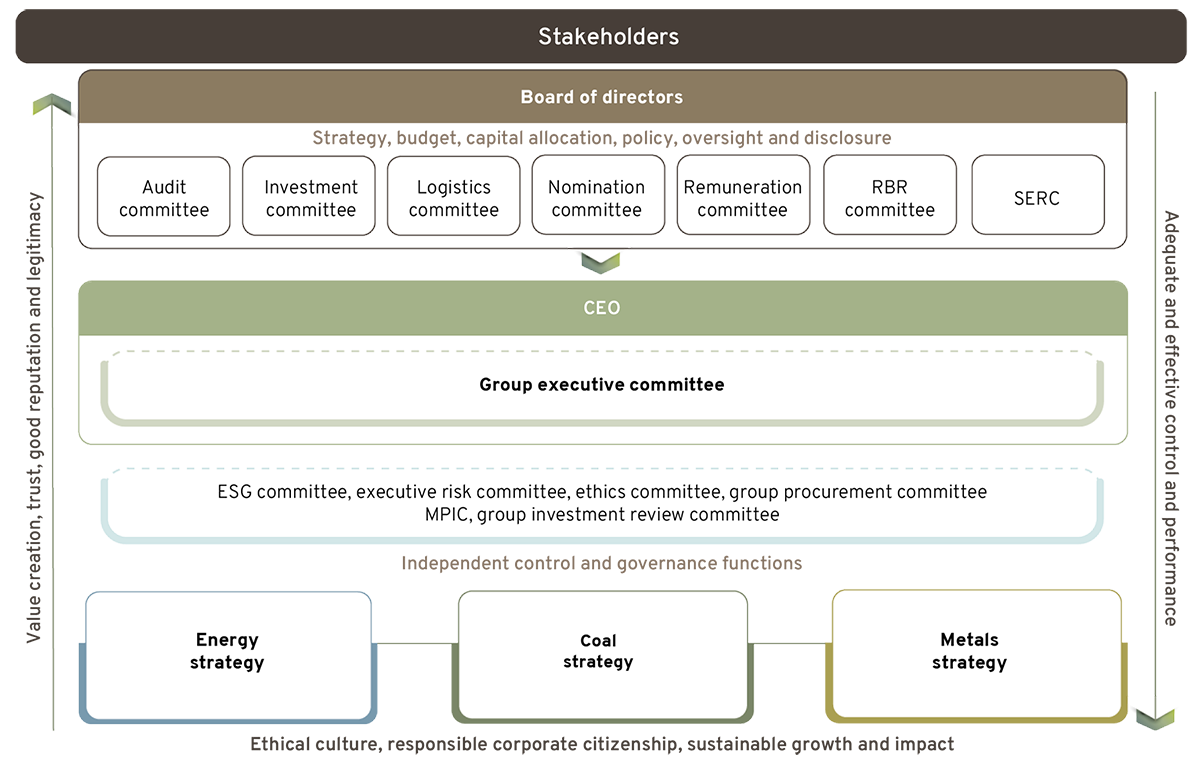
Exxaro’s corporate governance structure supports our ability to create value in the short, medium and long term. Through this structure, the board exercises effective control and safeguards the organisation’s reputation and legitimacy. Good corporate governance is the responsibility of our board, executive management, senior management and all employees.
Board committees enhance efficiency by providing focused expertise on specific areas, allowing the board to address a broader range of issues. When used effectively, committees enhance the objectivity of the board’s judgement. To facilitate the execution of its functions, the board delegates activities to board committees through formal terms of reference.
The board retains full and effective control of business and company affairs and does not assume management functions, which remain the responsibility of the executive directors, prescribed officers and other senior management.
| Audit committee* |
To fulfil the statutory functions set out in section 94 of the Companies Act and assist the board with independent oversight of the quality and integrity of, among others, the company’s financial statements |
|
| Investment committee** |
To monitor and report to the board on material acquisition, merger, investment or disposal opportunities and related ongoing material transactions within the scope of the energy and metals businesses |
|
| Logistics committee** |
To develop long-term logistics solutions to access international markets for coal and metals, and identify medium-term solutions and alternatives to mitigate rail capacity risk |
|
| Nomination committee** |
To assist the board with director recruitment in fulfilment of the nomination process, oversee the board’s effectiveness evaluation process and evaluate the adequacy and efficiency of the group governance structure and practices |
|
| Remuneration committee** |
To ensure the group remunerates fairly, responsibly and transparently and to ensure compliance with the JSE Listings Requirements and related reporting obligations |
|
| RBR committee** |
To ensure that risk management strengthens the company’s ability to achieve strategic objectives by providing annual assurance of business resilience in a changing environment, enabling the company to deliver on its objectives, survive and prosper |
|
| SERC* |
To advise the board on the fulfilment of the statutory duties set out in regulation 43 of the Companies Act, oversee the company’s significant impacts on the economy, environment, society and broader public interest, and ensure negative impacts are effectively mitigated |
|
* Appointed by shareholders.
** Appointed by shareholders.
Chairpersons
The chairpersons of the board committees consult regularly to collaborate on areas of shared responsibility, activity and interest across the different committees.
Terms of reference
The board approved its committees’ terms of reference and annual work plans in November 2025 and the 2026 key focus areas in the first quarter of 2026.
Board confirmation
The board confirms that it is satisfied that the board committees executed their roles and responsibilities. In this regard, the board confirms that the audit committee executed the responsibilities set out in paragraph 5.7(h) of the JSE Listings Requirements.
The board recognises the statutory and fiduciary duties of directors of subsidiary companies. Directors must always act in the best interest of the subsidiary company, irrespective of their nomination by the company in its capacity as the holding company. If a conflict arises between a director’s duties to a subsidiary company and the interests of the holding company, the director’s duties to the subsidiary company prevail.
The group governance framework mitigates potential tension between the holding company and subsidiary boards. Subsidiary directors must adhere to the framework and adopted group policies. However, this does not absolve them from exercising their fiduciary duties. Directors who breach their fiduciary duties may be held liable under section 77 of the Companies Act. This responsibility is clearly articulated to all our subsidiary directors.
The group control and oversight functions are responsible for providing enterprise-wide oversight of operational management and integrated reporting. Our group control and oversight functions include:
The board is responsible for overseeing the effectiveness of these oversight functions and ensuring an effective internal control environment within the group.
The board plays a proactive role in overseeing our ERM processes, ensuring that risks which could impact our strategic objectives are carefully monitored and managed. Our strategic risk register is regularly updated to accurately reflect Exxaro’s current risk exposures and to outline the mitigation actions taken to address identified risks. The strategic risk profile, which outlines the group’s key risks – along with Cennergi’s top risks – is reported quarterly to the RBR committee and the board.
We continuously review and update our ERM framework to ensure it remains aligned with evolving governance standards and regulatory requirements. The company regularly evaluates the framework’s effectiveness, making improvements where necessary.
The board governs technology and information management to support the organisation in setting and achieving its strategic objectives.
The board mandated the RBR committee to oversee Exxaro’s information management strategy, including governance, the integration of the improvement programme’s direction and objectives, and alignment with the enterprise business strategy, governance framework and risk management.
In addition to the RBR committee’s oversight, the audit committee is responsible for ensuring adequate information management governance.
Our governance structures are supported by key ICT policies that guide the use, management and security of technology across the organisation. The board reviewed and approved the acceptable use of ICT systems and services policy and security policy to ensure they remain aligned with current regulatory requirements, risk considerations and evolving operational needs.
Information management risks and mitigation measures are monitored continuously, including assessment of emerging risks, and reported to the RBR committee quarterly.
Cybersecurity remains a material risk in the organisation due to the rapidly changing threat landscape. We enhanced our cybersecurity posture through targeted improvement initiatives, and the enterprise information management risk register was reviewed and refreshed to ensure emerging cyber and technology risks are actively managed. Several cybersecurity awareness campaigns were held across the organisation to reinforce employee awareness and encourage safer digital behaviours, recognising that informed employees are a critical line of defence against cyber threats.
Disaster recovery preparedness remains a priority. Continuous testing is conducted to ensure that critical systems and services can be effectively restored in the event of failure, thereby enhancing organisational resilience and continuity.
The group is committed to:
Maintaining high standards of integrity, professionalism and ethical behaviour in our relationships
Conducting our business in adherence to statutory, supervisory and regulatory requirements
Complying with the letter and spirit of the law and regulations governing our conduct by ensuring the organisation acts with due skill and diligence
While we ensure compliance with relevant regulatory requirements in our jurisdictions, the law serves as a minimum standard of conduct, building a culture beyond complying with the law at all levels.
Our compliance philosophy is captured in a board-approved group compliance policy, which supports ethical and responsible corporate citizenship and seeks to create sustainable value for all stakeholders by promoting operational efficiency, growth and regulatory compliance with applicable laws. The group compliance policy was approved by the board in 2025.
The board is responsible for ensuring that the group and our employees comply with all applicable laws and regulations and considers non-compliance a key risk. Accordingly, the board delegated responsibility for managing Exxaro’s compliance risks to the RBR committee.
The RBR committee is responsible for:
The FD is responsible for providing a compliance and regulatory compass to the group by promoting a culture of compliance and regularly reviewing the regulatory environment.
Exxaro applies a combined assurance model, while fostering a strong ethical climate and effective compliance mechanisms.
We remain committed to continuously enhancing our combined assurance process to ensure it remains effective, adaptive and aligned with emerging risks and best practices. Through ongoing evaluation and collaboration among assurance providers, we strive to strengthen our oversight and risk management framework, fostering a culture of transparency and accountability.
The audit committee is responsible for overseeing the use of the combined assurance model to achieve the following objectives:
 |
Enabling an effective internal control environment |
 |
Ensuring the integrity of information used for decision making by management, the board and its committees |
 |
Supporting the integrity of external reports |
The combined assurance model, based on the five lines of assurance, functions through the combined assurance forum. The forum coordinates assurance for our risk exposure, as identified and ranked by the risk management function and aligned to King IV recommended practices for assurance. The forum’s activities and outcomes of assurance reports are presented quarterly to the audit committee.
The combined assurance plan’s focus areas align with the group’s strategic risk profile, with input from assurance providers. The plan considers the assurance level provided in giving the audit committee and board confidence regarding the effective functioning of the internal control environment. Executing the assurance plan ensures the audit committee receives the assurance required to assess the effectiveness of the risk management function and the control environment.
Exxaro uses an issue tracking management system to capture and track the status of audit findings. This enables visibility and accountability when addressing identified control weaknesses. All overdue and repeat findings are reported at each audit committee meeting.
Exxaro’s internal audit function is partially outsourced to the PwC consortium under the management control of Exxaro’s head of internal audit. The internal audit function’s responsibilities are detailed in the internal audit charter, which the audit committee reviews and approves annually. The charter informs the role and scope of work of the internal audit function.
To ensure the independence of our audit and assurance functions, the following measures are in place:
The board and audit committee are satisfied with the effectiveness of controls for the year ended 31 December 2025. This conclusion is supported by a formal combined assurance model, which is designed to optimise the assurance obtained from management, internal audit, external audit and other assurance providers.
The combined assurance approach enables a coordinated and integrated assessment of significant risks and controls, enhances assurance coverage and supports the integrity of the group’s reporting. Based on the results of the combined assurance processes and the information presented, the board and audit committee did not identify any material breakdowns in the system of internal control during the reporting period.
Combined assurance for effective governance
The board considered the JSE compliance certificate for the reporting period, confirming the company’s compliance with the JSE Listings Requirements, Debt and Specialist Securities Listings Requirements, and every disclosure requirement for continued listing on the JSE imposed in 2025. The required compliance certificate is submitted annually to the JSE through the group’s sponsors.
The board ensures the integrity of the company’s integrated report and its alignment with best practice in integrated reporting, including other reporting by the company. It also oversees the publication of our annual financial statements, ESG report, board committee reports, remuneration report and other online or printed information that complies with legal requirements and meets the legitimate and reasonable information needs of stakeholders.
The RBR committee reviewed the company’s insider dealing policy in 2025 to ensure it complies with the JSE Listings Requirements, Financial Markets Act, 2012 (Act 19 of 2012) and Companies Act, and aligns with the company’s code of ethics. The policy applies to directors, prescribed officers, employees and consultants.
The insider dealing committee provides guidance and clarity to employees and directors on insider trading, price-sensitive information and prohibited or closed periods.
We provide ongoing online training via the MyNexxt platform to directors, prescribed officers, employees and consultants to ensure an in-depth understanding of the policy, regulatory environment and controls.
The board is satisfied that the controls in place ensure regulatory compliance.
The company’s lead equity and debt sponsor, Absa Bank Limited, and joint equity sponsor, Tamela Holdings Proprietary Limited, perform the continuing obligations in connection with Exxaro’s listing on the JSE. The board is satisfied that the sponsors executed their mandate with due care and diligence in 2025.
Exxaro’s board applies a stakeholder-inclusive approach in accordance with King IV, supporting governance outcomes, including ethical culture, sustainable performance, effective control and organisational legitimacy.
The legitimate and reasonable needs, interests and expectations of material stakeholders are considered through structured engagement processes and monitored via prioritised stakeholder and ESG-related KPIs, which are incorporated into the group’s strategic performance dashboard.
Oversight of these KPIs is delegated to the relevant board and executive committees, enabling focused monitoring, accountability and transparent disclosure of stakeholder relationship management outcomes.
The board ensures Exxaro’s strategy and conduct reflect our purpose of powering better lives in Africa and beyond, and to be a responsible corporate citizen in giving effect to our purpose.
Exxaro is an integral part of society, and, as such, the board ensures the company’s efforts to be a responsible corporate citizen. This includes compliance with the South African Constitution (including the Bill of Rights), the law, leading international and national standards, and our codes of conduct and policies.
The board exercises independent judgement in overseeing management and safeguarding the interests of all stakeholders, including our shareholders. In fulfilling its stewardship role, the board seeks to instil and foster a corporate environment founded on integrity and provide management with sound guidance in pursuit of long-term stakeholder value, ensuring that the company offers sustainable value to society as a whole.
It is the SERC’s role to entrench responsible corporate citizenship as part of its focused activities. The committee’s roles and responsibilities include overseeing the impact of the group’s activities and outputs on our status as a responsible corporate citizen in:
Fundamental to Exxaro’s purpose of powering better lives in Africa and beyond is our stance that all people have inherent fundamental human rights, regardless of their differences. As such, Exxaro is committed to respecting and upholding human rights for all people within our sphere of influence, where the company has the power to effect investment and development.
Embedding human rights in our business
Exxaro remains committed to supporting the 10 principles of the UNGC. These principles are embedded in our Sustainable Growth and Impact strategy, values, operations and stakeholder engagements, reinforcing our commitment to uphold them. Exxaro’s voluntary participation in the UNGC advances the case for responsible business practices and encourages our stakeholders to do the same. It holds us accountable to a global standard as we strive to become a catalyst for economic growth and environmental stewardship.
UNGC communication on progress
The importance of workplace safety receives focused attention at each board, board committee and executive committee meeting. This is achieved through a standing safety moment on all agendas, allowing for reflection and reporting.
In addition to the SERC’s mandate, the RBR committee is responsible for reviewing health and safety risks and focuses on reported HPIs and LTIs. The SERC monitors occupational health and notes the processes that may detect potential deterioration of certain organs and assist in reversing some diseases.