
Exxaro Resources Limited
Environmental, social and governance report for the year ended 31 December 2025


The minerals and energy sectors face persistent skills shortages and rapidly changing capability requirements, making effective talent management essential to securing the skills we need for operational excellence and future growth. Our employees expect clear career pathways, equitable access to development and support in building professional capabilities.
Investing in talent and leadership capacity strengthens our resilience and ensures we remain competitive and well positioned to deliver on our Sustainable Growth and Impact strategy.
SERC, RBR and investment committees
Oversees talent management priorities, monitors performance against strategic objectives and ensures alignment with DEI and social impact commitments
The executive head: people and performance sets the strategic direction for talent management, workforce capability, leadership development, DEI integration and organisational culture. This is supported by our newly established talent review committee
Line managers, BU management teams and the people and performance department implement talent management processes, support career development, manage recruitment and mobility workflows and coordinate learning and development programmes
Our talent strategy supports a capable, engaged and representative workforce that can adapt to evolving business needs. We focus on strengthening our talent pipelines, developing future capabilities and ensuring that employees have fair access to opportunities for growth and advancement. Our approach integrates workforce planning, employee experience and transformation to support long-term performance.
Key elements of our approach include:

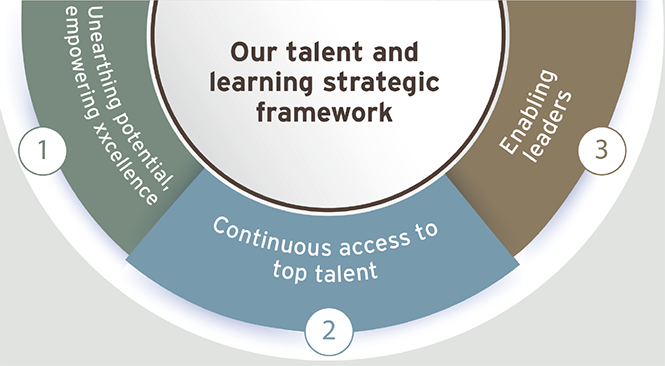
1 Unearthing potential, empowering xxcellence Recognising and developing unique talents, skills and competencies that Exxaro employees possess to break down barriers and limitations. Allowing employees to reach their full potential and achieve individual and business goals.
2 Continuous access to top talent Fuelling our future by attracting, retaining and empowering top talent to thrive and succeed in today’s competitive business landscape and grow more effectively, achieving Exxaro’s goals in the process.
3 Enabling leaders Enabling values-based leadership to create an environment based on opportunities that allows individuals to grow, develop and thrive in their careers, enhancing their overall performance and driving innovative thinking, positive behaviour and productivity.
Achieving our current and future business objectives depends on recruiting and retaining the best talent. We attract and retain individuals who are capable, values-driven and aligned with our purpose. This requires a strong employer brand and culture, coupled with competitive remuneration and access to development opportunities. This is further reinforced by maintaining a compelling employee value proposition to support our talent attraction and retention efforts.
We use a combination of digital and partnership-driven channels to broaden access to skilled candidates across priority talent segments. This includes:
We prioritise internal mobility to support growth, retain institutional knowledge and foster development. Employees may apply for opportunities without requiring line-manager approval, supporting a culture of empowerment and greater access to career pathways.
We regularly refine our internal processes to support an agile employee experience. Policy improvements have clarified progression pathways, strengthened alignment with SLP commitments and streamlined performance and succession processes.
We spend above the required threshold for training and development under the Skills Development Levies Act. Our learning and development approach focuses on building the skills required to meet emerging operational demands, technology shifts and new capability requirements linked to Exxaro’s business transition. Training programmes are refreshed through collaboration between our people and performance and digital value chain teams, who monitor technological developments to keep learning content current.
Employees have access to a wide range of learning modalities, including classroom-based programmes, e-learning, simulators, virtual reality, webinars and masterclasses. Accredited short courses and formal studies build competencies in areas such as automation, neuroscience, data analytics, change management and digital business strategy.
Technology broadens access to learning and supports development. Digital platforms, which are accessed through Exxaro’s MyNexxt platform, enable employees to engage with learning content at their own pace and pursue career growth opportunities. Our capability system tool, called ulwaXXi, is a vital step in our digital transformation and automation journey.
Read the performance section for details.
Adult education and training equips employees with the skills needed to achieve National Qualification Framework level 1 (equivalent to grade 9). This supports functional literacy, safety communication and access to further training and career progression.
We also offer portable skills programmes in welding, plumbing and civils to address broader entry-level development needs and build foundational competencies that support progression into higherlevel roles.
A strong leadership pipeline is critical to maintaining a diverse and future-fit workforce. Our programmes develop leadership behaviours, technical competencies and professional readiness, preparing employees to step into future roles that respond to a changing metals and energy environment.
Our leadership development pathways equip employees for new technologies, evolving operating models and emerging leadership demands. This includes structured leadership programmes, accredited management studies and targeted initiatives that support progression into critical and scarce-skills roles.
These programmes are complemented by accredited short courses, formal studies and occupational qualifications that support readiness for opportunities linked to renewable energy, digitalisation and the broader transition in our sector. Our leadership programmes are delivered in partnership with accredited business schools.
We are building a strong pipeline of critical skills, with a focus on sector-wide shortages in science, technology, engineering and mathematics fields. We identify and support full‑time students in priority disciplines, including engineering, data science, information technology, geology and business support services, with a deliberate emphasis on candidates from our host communities.
Our three-year PIT programme serves as a core pipeline for technical and leadership talent. The programme blends academic learning with structured workplace exposure, supported by mentors and technical coaches who guide participants through rotations across operational and functional areas. Leadership development prepares graduates for future roles and professional registration. New learners are enrolled with the Mining Qualifications Authority (MQA) and for leadership capability development, they form part of Exxaro leadership development programmes which are accredited with the Institute of Higher Learning and Development.
We advance our DEI strategy by creating development and employment opportunities for marginalised groups, including women, people with disabilities and students from our host communities. These efforts strengthen future talent supply and support long-term employment equity objectives.
We prioritise the development and progression of employment equity candidates, with a focus on black people, women and people living with disabilities. Vacancies at all levels are considered through this lens and succession planning structures prepare black employees and women for advancement into critical and leadership roles.
We continue to strengthen inclusion for people with disabilities through targeted education and empowerment interventions. Holistic support is integrated across our DEI and disability strategies, improving access to learning, development and career opportunities.
Women remain a priority talent segment across the organisation. Our BUs strengthen inclusion through women in mining committees and leadership initiatives that promote professional growth and safe working environments.
Our approach to growing the women in mining pipeline includes:
Fast-tracking, mentorship and executive coaching
Gender mainstreaming and sexual harassment awareness
Career-planning support for young women in our communities through programmes such as Edumap
Increasing representation of black women in feeder schemes and talent pathways through employment equity plans
Access to leadership development through the women in mining and women in leadership forums
Progression into technical and leadership roles through the PIT programme and other empowerment initiatives
These interventions support retention and progression of women across engineering, mining and professional disciplines.
We collaborate with employees, communities, industry bodies, training authorities and programme partners to strengthen our talent pipeline, expand access to skills development opportunities and support national socio-economic priorities such as youth employment.
We work with sector-focused institutions to support capability development and ensure alignment with industry standards and regulatory requirements. Key partnerships include:
| People development training expenditure | 2025 | 2024 | 2023 | |
| Total training (Rm) | 399 | 402 | 358 | |
| Total training (% of total payroll) | 5.82 | 6.75 | 6.22 | |
| Training of black people (Rm) | 364 | 363 | 318 | |
| Black people trained (% of total payroll) | 5.31 | 6.08 | 5.54 |
Building Exxaro’s capability
R399 million
invested in training and development
Developing core operational skills
R174 million
directed to functional and technical training
Growing the future talent pipeline
R180 million
for bursaries, learnerships, internships and professional programmes
Preparing employees for leadership roles
R5 million
invested in leadership and management development
Average hours of employee training by gender
214 hours for male employees
274 hours for female employees
Average hours of employee training by employee category
1 636 hours for middle management
840 hours for senior management
We introduced a reimagined succession planning framework in 2025 to elevate the maturity and consistency of our leadership pipeline processes. The new framework integrates succession analytics, providing greater alignment between employee aspirations and organisational requirements, and creating a strong talent bench of future-ready successors. Talent reviews in 2025 improved visibility of bench strength and development needs for certain critical roles, strengthening succession readiness and targeted development planning.
To reinforce governance and provide strategic oversight, we established the Exxaro talent review committee, a sub-committee of the executive committee. The talent review committee endorses talent mobility decisions and validates succession progress for our leadership and emerging talent. We implemented several talent movements in line with the committee’s recommendations.
We also introduced a new promotions policy, which ensures Exxaro’s promotional decisions are aligned to our talent, transformation and succession strategies. The policy formalises in‑role promotions and enhances the transparency and fairness of progression opportunities across the business.
As part of our employer branding and attraction strategy, we optimised our LinkedIn Life Tabs to create a dynamic and authentic digital space that highlights our culture, values and employee experience.
The refreshed platform provides prospective candidates with a clearer view of life at Exxaro, including our commitment to DEI, sustainability and community impact. Curated content and employee storytelling strengthen candidate engagement and position Exxaro as an employer of choice aligned with our long‑term vision.
Mentorship training began at Matla and Grootegeluk, equipping mentors with the skills to guide colleagues and support mentees in taking ownership of their development. The initial roll-out has been well received, with strong participation and engagement.
Building on this progress, mentorship training will roll out across the business in 2026. This phased approach ensures sustainable integration of mentoring practices, strengthens talent pipelines and supports knowledge transfer across the organisation.
In July 2025, we introduced a group-wide individual development plan dashboard to ensure that employees have a development plan in place. BU-specific dashboards are now embedded across the group, supporting consistent monitoring of employee development. Although implementing tailored plans for all employees, including blue-collar workers, presented challenges, our learning and development practitioners worked closely with BUs to ensure that individual development plans reflect role-specific development needs rather than safety compliance alone.
During the year, 27.27% of total female employees and 48.90% of total male employees received performance and career development reviews in line with their plans. Furthermore, 82.94% of total middle management employees and 64.95% of total senior management employees received performance and career development reviews.
ulwaXXi, launched in August 2025, advances our digital transformation journey by replacing manual bursary and external training processes with an SAP-enabled integrated workflow.
Named after the isiZulu word for “knowledge”, it improves accuracy, turnaround times and transparency, streamlining undergraduate and postgraduate bursary applications and external training requests.
We expanded our digital learning ecosystem to strengthen learning and support the development of core and critical skills. New platforms, including Bookboon, EduMine and the eXXsight Academy, were introduced alongside existing resources such as Udemy and LinkedIn Learning. To increase utilisation, we host masterclasses and share digital collateral that highlights available content and encourages employees to upskill and reskill in line with emerging capability requirements.
External recruitment remains focused on bringing in scarce and critical skills, particularly in senior roles where targeted appointments support transformation priorities.
Middle management (Paterson D band)
Senior management (Paterson E band)
Talent bench
D band bench: 17.8%RA (2024: 23.8%)
E band bench: 32.6%RA (2024: 27.9%)
B-BBEE
bursary element: 0.13% (2024: 0.69%)
Changes in organisational structures and the leadership landscape, new roles created and the revised succession framework and approach affected our talent bench movements.
| RA | Reasonable assurance provided. |
Succession planning and leadership development strengthen our internal pipeline, with internal promotions demonstrating the depth of our talent bench within the organisation. In 2025, we received 2 325 applications for internal growth opportunities at Paterson DL band and higher, compared to 3 646 in 2024. The higher volumes of job applications in 2024 are attributed to the organisational effectiveness project.
| Courses and number of interventions | 2025 | 2024 | |
| ESG and risk | |||
| Climate change | 7 | 35 | |
| Anti-bribery and anti-corruption | 7 741 | 727 | |
| Confidentiality | 191 | 103 | |
| DEI courses such as workplace harassment | 38 | 612 | |
| Exxaro Leadership Way | 0 | 15 | |
| Risk management framework | 64 | 20 | |
| Implicit and unconscious bias | 118 | 61 | |
| Performance | |||
| Performance management | 29 | 37 | |
| Information technology and cyber | |||
| Cybersecurity | 3 395 | 146 | |
| Microsoft Office | 74 | 144 | |
| Adapt to 4IR | 71 | 126 | |
| Managing innovation | 0 | 3 | |
| Management | |||
| Beyond budgeting management thinking | 3 | 33 |
Progress across key digital platforms included:
480 employees registered for open-source online courses
(LinkedIn, Udemy, Coursera), with 35% utilisation
(2024: 108
registrations; 8% utilisation)
3 638 training interventions completed on the voluntary
MyNexxt e-learning platform
(2024: 6 788)
115 072 compliance-related courses completed through
MyNexxt
(2024: 99 395)
Powering Knowledge achieved 91% utilisation among youth
development participants
(2024: 94%)
Participation in adult education and training remains low due to workforce demographics, but there is ongoing demand for portable skills training.
| 2025 | 2024 | 2023 | ||
| Investment (Rm) | 0.49 | 0.97 | 0.95 | |
| Employees enrolled | 1 | 1 | 0 | |
| Community members enrolled | 8 | 61 | 125 |
Exxaro promotes a culture of continuous learning to unlock potential, ignite innovation and build a sustainable future for our business and communities.
To support this, we offer portable skills programmes in welding, plumbing and civil to address broader entry-level development needs and build foundational competencies that support progression into higher-level roles.
| 2025 | 2024 | 2023 | ||
| Investment (Rm) | 8 | 9 | 6 | |
| Employees enrolled | 57 | 136 | 139 | |
| Community members enrolled | 503 | 659 | 391 | |
| Trade tests completed | 116 | 49 | 28 |
144 employees completed leadership programmes
123 employees enrolled in management development programmes
22 employees took part in the UCT Graduate School of Business Women in Leadership programme
| Leadership programmes | Occupational level |
Number of employees | |||
| 2025 | 2024 | ||||
| Leading programme | E band | 0 | 0 | ||
| Leadership in connected | Paterson DM/DU band | 27 | 18 | ||
| Essential leadership | DL level | 43 | 33 | ||
| Launchpad leadership | below Paterson | 52 | 19 | ||
| Nano sessions | DL | 0 | 32 | ||
| Women in leadership | Paterson C band | 22 | 52 | ||
These programmes are complemented by accredited short courses, formal studies and occupational qualifications that support readiness for opportunities linked to renewable energy, digitalisation and the broader transition in our sector.
Our learning strategy remains an important enabler of capability development and succession planning for specialist and management roles.
| Formal studies | Total enrolled | Black people | Black women | |
| Postgraduate1 | 39 | 37 | 27 | |
| Undergraduate1 | 21 | 21 | 10 | |
| New skills short courses2 | 6 | 5 | 2 |
| 1 | South African universities. |
| 2 | South African and international universities. |
We had 80 employees who participated this year, of whom 62% were black people and 52% black women. This compares to 17 participants in 2024 (88% black people and 47% black women). There was no mentorship training in 2024 due to operational effectiveness process.
Women represented 56% of employees in mentorship training in 2025 (2024: 47%).
80 full-time bursars in engineering and mining disciplines
R10.8 million invested in bursaries to help address engineering skills shortages
32 full-time tertiary bursaries awarded to Edumap graduates and youth from Exxaro’s communities
32 full-time tertiary bursaries awarded to Edumap graduates and youth from Exxaro’s communities
In 2025, we introduced the EduMine platform to provide mining experience using Exxaro technologies, prepare learners and employees for future operational needs, and potential merger and acquisition activities. Since the launch, 17 participants have enrolled, 11 have completed their courses and six are still in progress.
| Feeder schemes | In training | Black people | Black women | |
| Engineering learners | 157 | 150 | 59 | |
| Miner learners | 349 | 348 | 153 | |
| Operator learners | 557 | 553 | 297 | |
| Internships | 130 | 130 | 73 | |
| Business administration learners | 94 | 94 | 70 |
2025 enhancements include:
Although interview simulations were ultimately not required, the guide will be shared with the broader bursary cohort.
| 2025 | 2024 | ||
| PIT programme graduates in the talent pipeline | 76 | 82 | |
| Candidacy | 4 | 4 | |
| Bursars | 167 | 163 | |
| Bursars for people living with disabilities | 30 | 32 | |
| Percentage of black South Africans | 98% | 94% | |
| Total programme cost | R77 million | R64 million |
| 2025 | 2024 | ||
| Female employees in the workforce | 35% | 33% | |
| Female PIT graduates | 71% | 65% | |
| Black female full-time bursars in engineering and mining disciplines* | 52% | 61% | |
| Women in learnership and internship feeder schemes | 50% | 52% | |
| Number of black women sponsored at Technical and Vocational Educational Training (TVET) colleges for access to formal learnerships | 51 | 20 |
| * | South Africans at local universities. |
| 2025 | 2024 | ||
| Black South Africans with disabilities supported at local tertiary institutions (full-time studies) | 30 (53% women) | 30 (50% women) | |
| Internships for people with disabilities appointed (all black people) | 14 (43% women) | 3 (67% women) |
SME.TAX has supported youth employment and skills development since 2024 by recruiting 50 participants for a twoyear programme ending in April 2026. Success is measured by participants securing employment or launching cooperatives, contributing to small business development. The programme enables participants to move into employment or entrepreneurial ventures. Three learners found permanent employment and four are establishing their own businesses. The remaining 43 learners will be completing the programme in April 2026 and thereafter will be assisted in finding permanent employment.
Lularides trains youths in motorcycle operation, equipping them with learner’s licences and delivery driver certifications. Most trainees are placed as delivery drivers with companies such as Mr D in Centurion, Soweto, Middelburg, Witbank and Secunda. 148 participants completed motorcycle training in 2025.
Edumap College provides a 12-month bridging programme for matriculants from disadvantaged communities who demonstrate academic potential but do not yet meet university entrance requirements. The programme focuses on improving their maths and physical science results to enable access to institutions of higher learning. Since 2019, Edumap College has supported 110 students to improve their matric results. Building on this, students who completed the Edumap programme have been sponsored by Exxaro to further their studies, with 33 students enrolled since 2022.
Exxaro supports 32 active bursars through this initiative. Of these, 20 students who improved their results in 2025 and met university admission requirements are being considered for bursaries.

2026
key actions
Our focus for 2026 is to strengthen talent mobility and deepen organisational capability by introducing group-wide skills insights and structured development pathways. This includes: